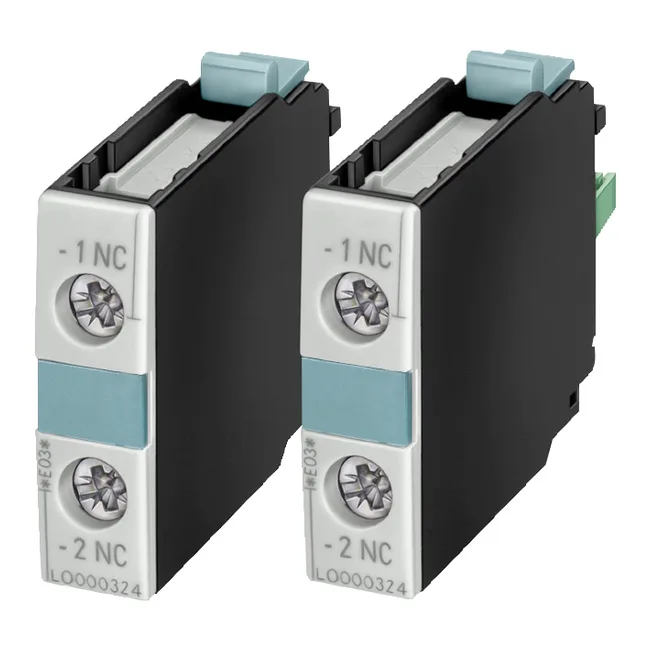
It's the add-on block that gives you isolated N/O or N/C feedback contacts for your PLC inputs, status lamps, or safety circuits — without taking up extra DIN rail space. Width is just 10 mm, so it stacks tight alongside the contactor body. Depth of 51 mm and height of 38 mm keep it inside the contactor's own envelope — no panel layout surprises when you're swapping a block in an existing build.
What the contact ratings actually mean for your circuit
Rated 10 A at AC-12 (resistive loads like heaters or lamps) and 6 A at AC-15 (solenoid and contactor coils) across 24 V and 230 V. For DC control circuits the ratings drop with voltage: 6 A at 24 V DC, 2 A at 48 V and 60 V, 1 A at 110 V, 0.3 A at 220 V. That's typical for a compact auxiliary block — the DC arc is harder to extinguish, so you derate accordingly. At higher AC voltages the switch still delivers: 3 A at 400 V and 1 A at 690 V AC-15.
Mirror contact — why it matters for safety circuits
This switch carries a mirror contact per IEC 60947-4-1 when used with the 3RT1 contactor range. That means the N/C contact is mechanically linked to the N/O contact — if the N/O welds shut, the N/C stays open. Safety-rated circuits (like emergency stop feedback or guard door monitoring) require this to guarantee a reliable off-state signal.
No REACH or UL listing is stated in the available records, but the SIRIUS series typically carries UL/CSA certification — confirm the specific mark with the factory if your panel requires it.
Wiring and installation notes
Terminals accept 2 x 0.5 to 1.5 mm² solid or stranded, or 2 x 0.75 to 2.5 mm² with ferrules. For AWG, that's 2 x 20–16 and 2 x 18–14. The spring-cage style holds firm under vibration — no screw retorque needed on a crusher or conveyor panel. Snap-on mounting means you push it onto the front of the S0 contactor until it clicks. No tools, no DIN rail. The IP20 front protection keeps fingers away from live terminals inside the enclosure. Contact reliability is specified at 1 faulty switching per 100 million at 17 V, 1 mA — that's the dry-circuit performance for low-energy PLC inputs.