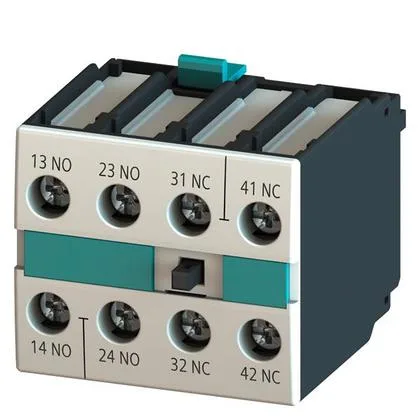
The Siemens 3RH1921-1FA22 is a 4-pole attachable auxiliary switch block from the SIRIUS family, configured 2 NO + 2 NC per EN 50005. It snaps onto 3RT1 contactors and contactor relays, adding auxiliary contacts for status feedback, interlocking, or control logic without extra wiring space. The block carries a 10 A maximum thermal current and is rated for AC-15 switching at 690 V up to 1 A, with a surge voltage resistance of 6 kV and insulation voltage of 690 V at pollution degree 3. Mechanical service life is 10 million switching cycles typical, with contact reliability of 1 faulty switching per 100 million operations at 17 V, 1 mA.
Contact ratings across voltages
The block's contact ratings are specified per voltage for DC auxiliary circuits: 10 A at 24 V, 6 A at 125 V and 230 V, 4.7 A at 60 V, 3 A at 110 V and 400 V, 1.2 A at 220 V, 0.5 A at 440 V, and 0.26 A at 600 V. These values govern the maximum switching current at each voltage level — match them to your control circuit's voltage and load to avoid overstressing the contacts.
Lifecycle and replacement
This part is marked as a phased-out product. The official successor is the SIRIUS 3RH2 series. For new designs or BOM freeze replacements, the 3RH2122-1WB40 is the closest functional peer — same 2 NO + 2 NC configuration, same 10 A at 24 V DC rating, same screw terminals, but with a larger footprint (73 mm depth vs 51 mm, 45 mm width vs 44 mm) and a higher mechanical life of 30 million cycles.
Snap-on mounting directly onto the 3RT1 contactor — no DIN rail required for the block itself. Screw-type terminals accept 2x (0.5 to 1.5 mm²) or 2x (0.75 to 2.5 mm²) with core-end processing, or 2x (20 to 16) and 2x (18 to 14) AWG.