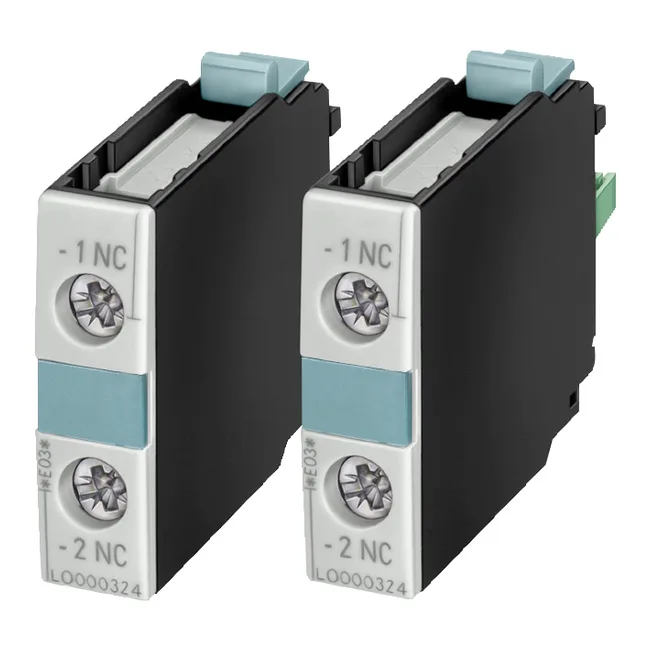
The Siemens 3RH1921-1FC22 is a SIRIUS auxiliary switch block designed for contactor relays and power contactors in the Size S0 through S12 range. It provides 2 normally-open and 2 normally-closed contacts (2 NO + 2 NC) with screw-type terminals, and snaps onto the contactor without tools — a standard DIN-rail panel integration move.
The block carries a maximum thermal current of 10 A. For DC-13 switching (solenoid loads), the rated current drops with voltage: 10 A at 24 V, 4.7 A at 60 V, 3 A at 110 V, 1.2 A at 220 V, 0.5 A at 440 V, and 0.26 A at 600 V. These are the values that govern real-world fit — a 24 VDC solenoid circuit can pull the full 10 A, but a 220 VDC circuit is limited to 1.2 A.
Lifecycle reality — phased out, successor available
This part is a phased-out product. The official successor is the SIRIUS 3RH2 series. For new designs, migrate to the 3RH2 family to avoid future migration debt.
Dimensions are 44 mm wide, 38 mm high, and 51 mm deep — compact enough for high-density panels. Surge voltage resistance is rated at 6 kV, and insulation voltage at 690 V AC with pollution degree 3.
Wiring and contact reliability
Screw terminals accept 2x (0.5 to 1.5 mm²) or 2x (0.75 to 2.5 mm²) conductors with core end processing, or 2x (20–16) and 2x (18–14) AWG. Mechanical service life is typically 10 million switching cycles.