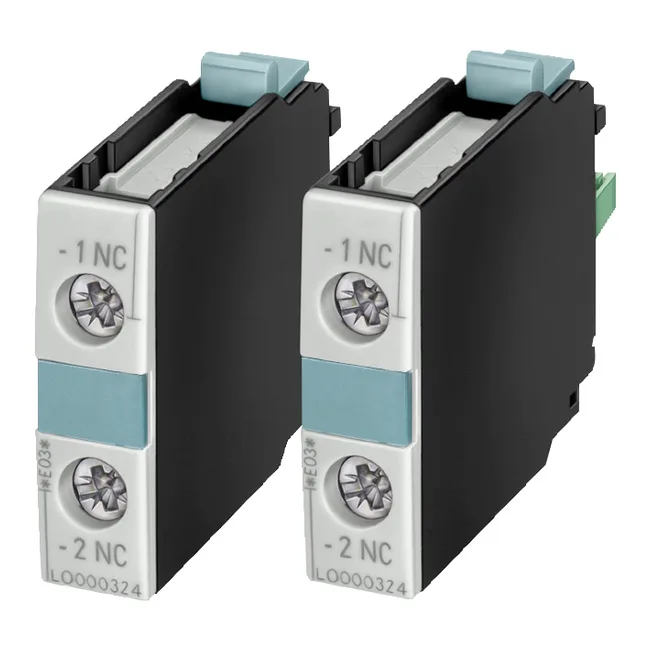
The Siemens SIRIUS 3RH1921-1FE11 is a solid-state-compatible auxiliary switch block designed to snap onto a 3RT1 contactor relay in size S0. It carries a single instantaneous NO contact rated at 0.3 A at both 24 V and 60 V — a low-energy signal rating, not a power-switching contact. The screw-type terminals accept 2x (0.5 to 1.5 mm²) or 2x (0.75 to 2.5 mm²) with core-end processing, or 2x (20 to 16) / 2x (18 to 14) AWG.
Lifecycle reality — phased out, successor identified
This part is a phased-out product. The official Siemens successor is the SIRIUS 3RH2 series. If you are maintaining a panel built around the 3RT1 / 3RH1921 platform, the 3RH2 is the drop-in replacement path for new builds or when spares run dry.
The 0.3 A contact rating at 24 V and 60 V tells you this switch is intended for PLC or electronic control inputs, not for pilot-duty solenoids or contactor coils directly. The mechanical life of 5 million switching cycles is typical for a block mounted on a contactor relay that itself cycles at lower frequencies. That puts it in the standard 400 VAC panel class for industrial control circuits.
Snap-on mounting onto the 3RT1 contactor relay in size S0. No DIN rail footprint of its own — it clips directly to the relay, adding 51 mm depth, 44 mm width, and 38 mm height to the assembly.