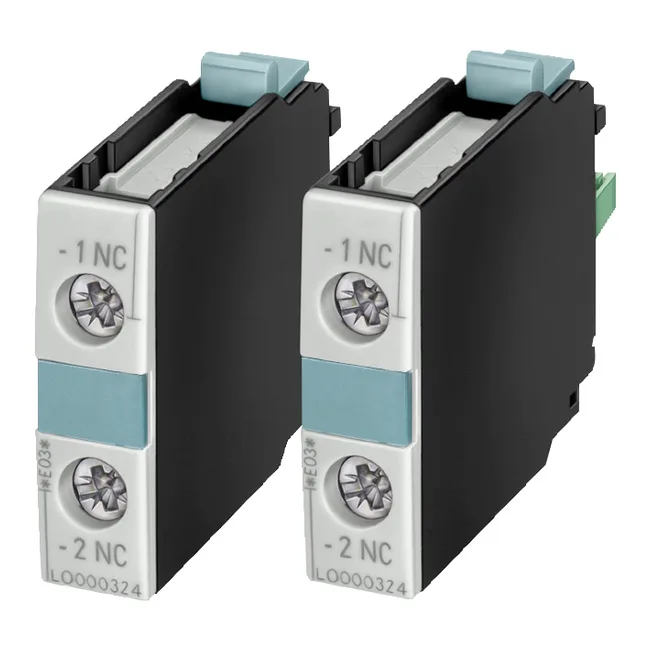
The Siemens SIRIUS 3RH1921-1RA10 is a 1-pole auxiliary switch block with one normally-closed (NC) contact, designed for side-mounting onto 3RT1 motor contactors. The screw-type terminals accept 2x (0.5 to 1.5 mm²) or 2x (0.75 to 2.5 mm²) conductors, or the AWG equivalents 2x (20 to 16) and 2x (18 to 14). This is a side-mounted block — it attaches to the side of the contactor, not the front. That means it adds auxiliary contacts without increasing the contactor's depth, which matters when panel depth is tight. The 10 mm width keeps the assembly compact.
What the current ratings mean for your circuit
The contact is rated 10 A maximum, but the actual switching capacity depends on the voltage and load type. At 24 V it handles 6 A (AC-15), and at 230 V it also carries 6 A. These are AC-15 inductive load ratings for solenoid valves, contactor coils, and similar loads — the typical use for an auxiliary contact. The 10 A maximum is the thermal continuous current; the voltage-specific numbers are what govern real switching life. For DC switching, the ratings are lower: 10 A at 24 V DC, 4.7 A at 60 V DC, 3 A at 110 V DC, 1.2 A at 220 V DC, and 0.26 A at 600 V DC. If you're switching a DC coil or a DC control circuit, use the DC column — the AC ratings don't apply.
This part is listed as a phased-out product. The official successor is the SIRIUS 3RH2 series auxiliary switch block. For existing panels, replacement units are sourced through the surplus and broker channel against an RFQ.
Rated for 10 million mechanical switching cycles typical.