What This Auxiliary Switch Block Is and Where It Fits
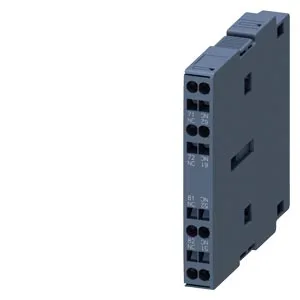
The 3RH1921-2EE02-ZX95 is a first lateral auxiliary switch block from the Siemens SIRIUS family, designed to snap onto the side of a 3RT1 contactor or contactor relay. The note 'with 3RT1' in the spec is the compatibility anchor — this block mounts specifically on that contactor series, not on a DIN rail or a different frame size. It provides 2 normally-closed (NC) contacts in an encapsulated housing, rated for solid-state compatibility. The spring-loaded terminals (cage clamp) accept 2x (0.5 to 2.5 mm²) without core end processing, or 2x (0.5 to 1.5 mm²) with ferrules, plus 2x (20 to 14 AWG) for auxiliary circuits.
Contact Ratings and Switching Reliability
The contact ratings vary by voltage: 0.3 A at 24 V and 60 V, 3 A at 110 V, and 1 A at 220 V. The 3 A at 110 V figure is the load-bearing spec for AC pilot duty in North American control circuits; the 1 A at 220 V covers European 230 V control loops. The 0.3 A at 24/60 V is the DC switching limit — relevant if you're switching a DC solenoid or indicator lamp. Contact reliability is specified at 1 faulty switching per 100 million operations at 17 V, 1 mA. This is the low-level signal reliability figure — it tells you the block can handle dry switching into a PLC input or solid-state load without the contact oxidation that plagues standard contacts at milliampere levels. Mechanical service life is 10 million switching cycles typical. That's a long-life block for high-cycle applications like packaging lines or conveyor systems where the auxiliary follows the main contactor every machine cycle.
Environmental and Electrical Ratings
The block measures 10 mm wide by 72.5 mm high by 71 mm deep — the 10 mm width is the space it occupies on the contactor side, so it adds minimal footprint to the contactor assembly. Snap-on mounting means it clips directly onto the 3RT1 contactor without tools. Rated insulation voltage is 500 V at pollution degree 3, with a surge voltage resistance of 6 kV. This covers 480 V panel applications with adequate clearance for transient overvoltages. IP20 on the front means finger-safe but not washdown — suitable for enclosed panels only. Operating temperature range is -25 to +60 °C, storage range -55 to +80 °C. The storage range is wider than operation, which matters if the block sits in a warehouse or on a shelf before installation.