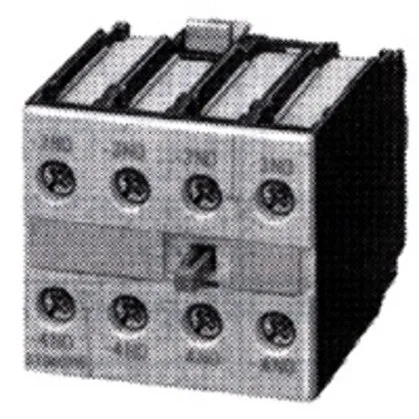
It snaps onto SIRIUS contactor relays and motor contactors in sizes S0 through S12, adding four auxiliary contacts to the base device. The contact arrangement follows EN 50005, so the NO and NC positions are standard for the SIRIUS family — no surprises when you wire it into an existing panel layout. Rated at 10 A maximum (AC-12), with a 690 V insulation voltage at pollution degree 3 and a 6 kV surge withstand, this block is built for industrial control panels where isolation and fault clearance matter.
The 10 A maximum is the thermal current (AC-12), but the real-world switching capability depends on voltage and load type. At 24 V it switches 6 A; at 110 V it drops to 1 A; at 230 V it handles 6 A again (likely a resistive or AC-15 rating at that voltage). The AC-15 rating at 690 V is 1 A — that's the inductive load curve for contactor coils or solenoid valves at line voltage. For DC switching, the block is rated at 24 V for 10 A, 60 V for 4.7 A, 110 V for 3 A, 220 V for 1.2 A, and 600 V for 0.26 A. That's a typical DC derating curve — arc extinction limits the current as voltage rises. If you're switching a DC solenoid or brake coil at 110 V, you have 3 A of headroom; at 220 V, keep the load under 1.2 A.
Lifecycle — phased out, with a direct successor
The 3RH1921-2FA22 is a phased-out product. The official Siemens successor is the SIRIUS 3RH2 series auxiliary switch block. For new designs or BOM-line replacements, the 3RH2 block uses the same spring-loaded terminal technology, same 2 NO + 2 NC contact arrangement, and mounts on the same SIRIUS contactor sizes. The panel footprint and wiring pattern are compatible, so a swap should not require rewiring.
Snap-on mounting onto the contactor — no tools needed. The spring-loaded terminals accept 2x (0.5 to 2.5 mm²) without core-end processing, or 2x (0.5 to 1.5 mm²) with ferrules. AWG equivalents are 2x (20 to 14). The block dimensions are 44 mm wide, 38 mm high, and 51 mm deep — it adds minimal depth to the contactor assembly.