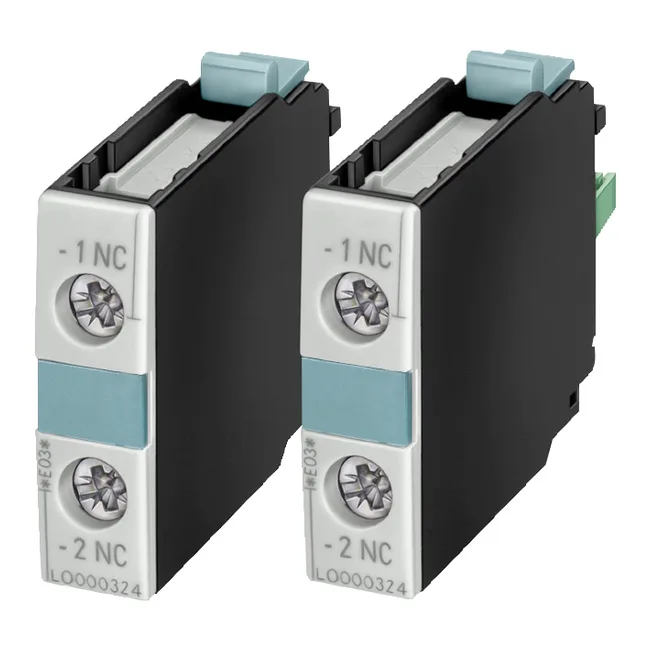
It uses spring-loaded terminals for the auxiliary and control circuit connections, accepting 2x (0.5 to 2.5 mm²) solid or stranded wire without ferrules, or 2x (0.5 to 1.5 mm²) with core-end processing. The block measures 51 mm deep by 44 mm wide by 38 mm high and carries an IP20 protection rating on the front face.
Lifecycle and replacement
This part is a phased-out product. The manufacturer lists the successor as the SIRIUS 3RH2 series auxiliary switch blocks. For new designs or a direct drop-in replacement, evaluate the 3RH2 series — the 3RH2131-2AK60 (3 NO + 1 NC, spring terminals, size S00) is the closest functional peer, though it mounts on size S00 contactors rather than the S0 through S12 range of the original.
The AC-15 rated operational current varies by voltage: 10 A at 24 V, 6 A at 125 V, 6 A at 230 V, 6 A at 250 V, 3 A at 400 V, and 1 A at 690 V. These are the inductive-load ratings for solenoid and contactor coils — the most common duty for an auxiliary block. The DC switching ratings follow a different curve: 6 A at 24 V, 4.7 A at 60 V, 3 A at 110 V, 1.2 A at 220 V, 0.5 A at 440 V, and 0.26 A at 600 V. The 10 A maximum applies across the board, but the voltage-specific derating is what governs real-world fit.
The spring-loaded terminals accept 2x (0.5 to 2.5 mm²) without ferrules or 2x (0.5 to 1.5 mm²) with ferrules; AWG equivalents are 2x (20 to 14). The 51 mm depth keeps the block within the envelope of the contactor it mounts on, so it does not increase the panel depth beyond the base device.