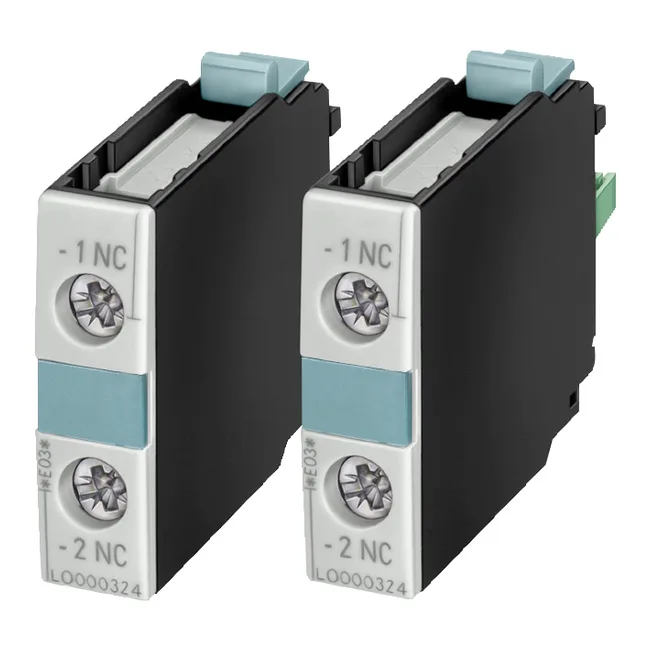
It snaps onto contactor relays and power contactors in the S0 through S12 frame sizes — the "with 3RT1" note on the listing means it's designed to mount directly on a 3RT1-series contactor, extending its auxiliary contact capacity without additional wiring space.
Contact ratings are given for both DC and AC-15 inductive loads — two different curves that govern where this block can be used. For DC switching: 10 A at 24 V, 6 A at 125 V and 230 V, 3 A at 400 V, and down to 0.3 A at 220 V. The AC-15 ratings (for solenoid and contactor coils) are 10 A at 24 V, 4.7 A at 60 V, 3 A at 110 V, 1.2 A at 220 V, 0.5 A at 440 V, and 0.26 A at 600 V. At 690 V AC-15 it's rated 1 A. These numbers define the maximum switched current at each voltage; the 690 V rating means it can handle control circuits on 690 V line supplies common in heavy industrial installations.
Integration notes
Snap-on mounting onto the contactor body — no DIN rail required, no screws. Dimensions are 44 mm wide, 51 mm deep, 38 mm high, so it adds minimal depth to the contactor stack. Spring-loaded terminals accept 2x (0.5 to 1.5 mm²) with ferrules or 2x (0.5 to 2.5 mm²) without; AWG equivalent is 2x (20 to 14). Front IP20 means finger-safe when installed in an enclosure.