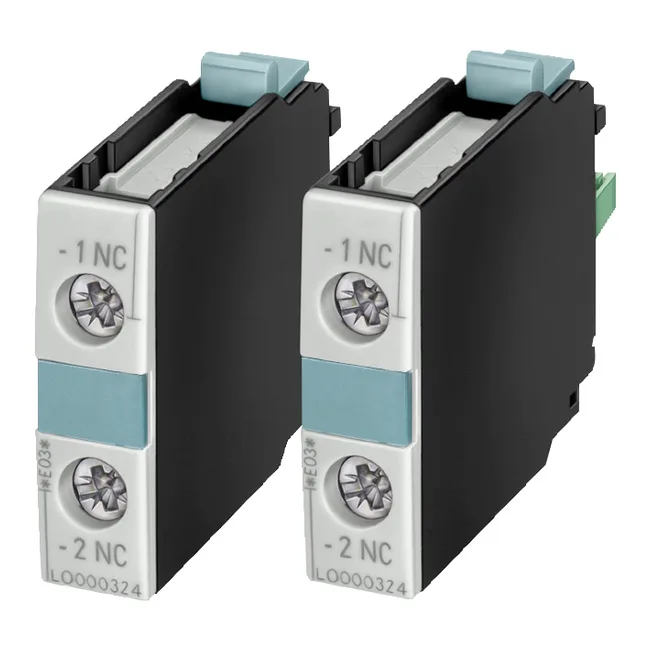
The Siemens SIRIUS 3RH1921-2HA22 is a 4-pole auxiliary switch block with 2 normally-open and 2 normally-closed instantaneous contacts, designed to snap onto 3RT1 contactors. It uses spring-loaded terminals for the auxiliary and control circuit connections, accepting 2x (0.5 to 1.5 mm²) with ferrule or 2x (0.5 to 2.5 mm²) without. Rated for a maximum of 10 A, with specific current ratings per voltage and duty: at 24 V it's rated 10 A (AC-12) and 6 A (DC-13); at 230 V it's 6 A; at 400 V it's 3 A. The AC-15 rating at 690 V is 1 A. These are the values that determine whether the block can handle the pilot duty or signal-level switching in your circuit — the 10 A headline applies only at low voltage and resistive loads.
The successor 3RH2 series (e.g., 3RH2422-1AB00) is a different form factor — 90 mm wide versus 44 mm, and 73 mm deep versus 51 mm — so it will not drop into the same panel footprint without mechanical rework. The terminal type also changes from spring-loaded to screw-type on that successor. If the BOM calls for this exact 3RH1921-2HA22, the replacement is not a simple swap; it's a panel redesign.
That's the low-level signal reliability — important if this block is switching PLC inputs or dry-contact signals where oxide film on the contacts can cause intermittent opens. Surge voltage resistance is rated at 6 kV, and the insulation voltage with pollution degree 3 is 690 V AC. That means the block is suitable for 400 V line-to-line control circuits in industrial environments where the pollution level is high (conductive dust or condensation).
Panel integration
The block is 44 mm wide, 51 mm deep, and 38 mm tall — it occupies one standard 45 mm-wide module position on the rail. It mounts directly onto the front of a 3RT1 contactor, not as a standalone device; the note "with 3RT1" means it's a clip-on accessory, not a separately wired block. Wiring: spring-loaded terminals accept 2x (0.5 to 1.5 mm²) with ferrule or 2x (0.5 to 2.5 mm²) without, or 2x (20 to 14 AWG). No screw torque to verify — the spring cage holds the conductor when the lever is released. Strip length per standard practice for this terminal type is 8 to 10 mm.