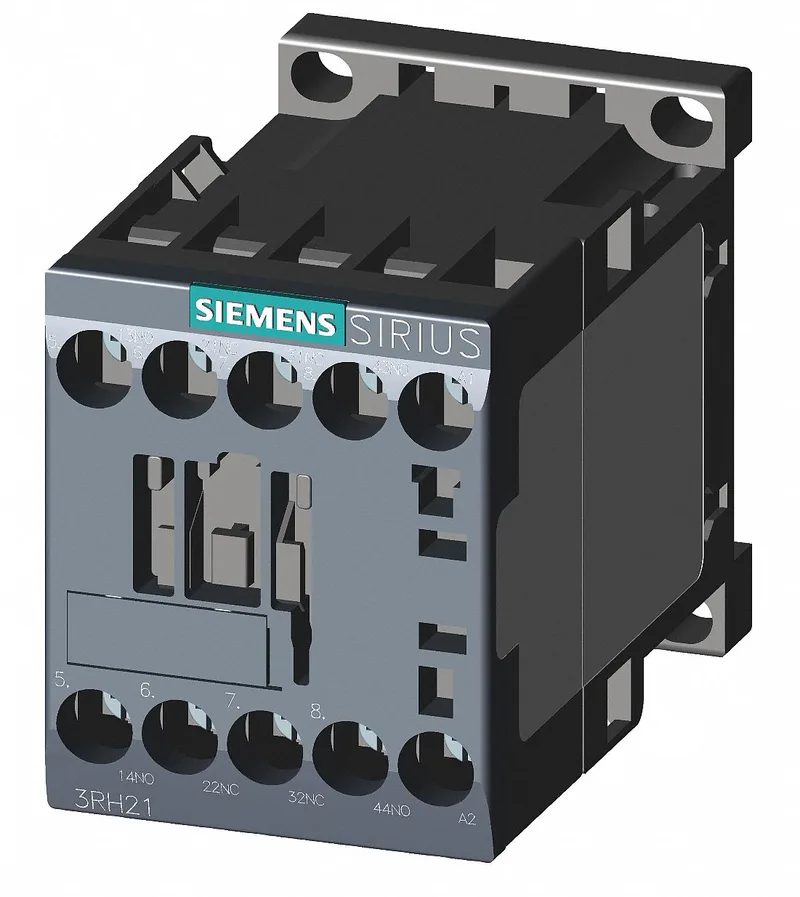
It carries 2 NO and 2 NC instantaneous contacts, rated for a 110 V AC coil. At 24 V AC the contacts handle 10 A resistive; at 110 V AC they switch 3 A, and at 230 V AC they hold 10 A — the 110 V AC rating is the one that governs the coil circuit, while the 230 V AC figure covers the load side for common line voltages.
Mounts via screw fixing or snap-on onto 35 mm DIN rail — the S00 frame width is 45 mm, depth 73 mm, height 57.5 mm. That keeps the panel footprint tight; you can fit several side by side on a standard rail section.
The lifecycle status is current production; it's a standard catalog item from the SIRIUS line, not a phase-out or NRND part. RoHS compliance date is October 1, 2009, covering the EU substance prohibitions.
Wiring and Contact Ratings
Terminals accept 2x (0.5 to 1.5 mm²), 2x (0.75 to 2.5 mm²), or 2x 4 mm² solid or stranded wire — spring-cage or screw terminals are typical for this series, though the evidence specifies screw and snap-on mounting. The instantaneous contacts are rated for 10 A at 24 V AC and 230 V AC, 4.7 A at 60 V, 3 A at 110 V, 1.2 A at 220 V, and derated at higher voltages: 0.5 A at 440 V, 0.26 A at 600 V, 1 A at 690 V.