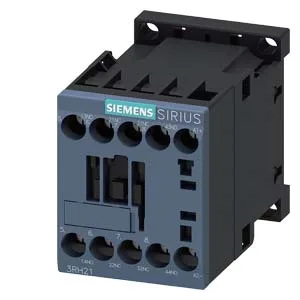
It carries 2 NO instantaneous contacts and is driven by a 110 V DC coil that draws 4 W during both pick-up and hold. That constant-power coil design means the control transformer doesn't see a current surge on closure; sizing the DC supply is straightforward. It belongs to the SIRIUS family and is built in the S00 frame size. The S00 footprint is the smallest in the SIRIUS contactor range — 45 mm wide, 57.5 mm tall, 73 mm deep — which keeps the DIN-rail fill factor tight when you're stacking multiple auxiliaries next to a main contactor.
Switching capability — what the DC ratings actually mean
The 110 V DC coil is the identity of this variant. The contact ratings are tabulated by voltage: at 24 V it switches 10 A, at 60 V it's 4.7 A, at 110 V it's 3 A, at 220 V it's 1.2 A, and at 600 V it drops to 0.26 A. These are DC-13 (solenoid/brake) load ratings — the current falls as voltage rises because DC arcs are harder to extinguish. If you're switching an inductive DC load like a brake coil or a solenoid valve, use the voltage row that matches your circuit; don't interpolate between rows. AC ratings are also present: 10 A at 230 V, 3 A at 400 V, 1 A at 690 V. For a signal-level auxiliary contactor those numbers are typical — the contacts are silver-alloy, sized for control-circuit duty, not motor inrush.
Clearance and environment
That's the spacing needed to avoid heat buildup and arc flashover between auxiliaries packed on the same rail. Relative humidity minimum is 10 % — the contactor is not damaged by dry conditions. The substance prohibition date of 10/01/2009 aligns with RoHS compliance; the part is RoHS-compliant and REACH-registered as standard for SIRIUS products.