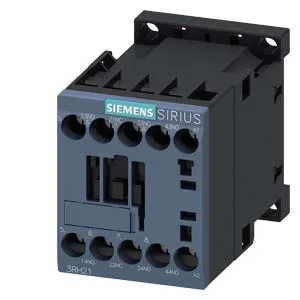
The Siemens 3RH2131-1AU60 is a SIRIUS auxiliary contactor in frame size S00, with 3 normally open instantaneous contacts. It's the switching block for signaling and control circuits in a motor starter or contactor assembly — not the main power path, but the logic side that tells the PLC or HMI what the main contacts are doing. The switching capacity drops predictably at higher voltages — 3 A at 400 V AC, 1.2 A at 220 V DC — so the buyer matches the voltage column to their control transformer tap.
The S00 frame footprint is 45 mm wide by 73 mm deep by 57.5 mm tall — a compact block that fits in a crowded panel without stealing space from the main contactor. These are the minimum air gaps to maintain rated insulation and heat dissipation — an integrator laying out a dense row of S00 devices should respect those numbers to avoid derating.
Terminals accept 2 x (0.5 to 1.5 mm²), 2 x (0.75 to 2.5 mm²), or 2 x 4 mm² solid or stranded copper, plus the AWG equivalents (2 x 20-16, 2 x 18-14, 2 x 12). That covers the range from signal-level wiring up to the heavier gauge needed for longer control runs. Screw-clamp termination is standard for this class — no spring-cage option on this variant.
The substance prohibition date of 10/01/2009 confirms RoHS compliance for the European market.