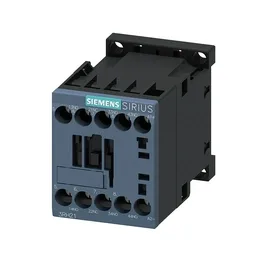
It carries three instantaneous normally-open contacts and is driven by a DC coil with a built-in varistor surge suppressor. The part screws or snaps onto a standard 35 mm DIN rail, occupying a 45 x 58 mm footprint and 73 mm depth — a panel-builder's dimension that fits alongside other S00 auxiliaries without crowding.
DC switching ratings — what the voltage columns mean
This relay's DC switching capability is given as a table of rated values per voltage, not a single blanket current. At 24 V it switches 10 A; at 60 V, 4.7 A; at 110 V, 3 A; at 220 V, 1.2 A; at 440 V, 0.5 A; at 600 V, 0.26 A. There are also AC-rated entries at 230 V (10 A), 400 V (3 A), 500 V (2 A), and 690 V (1 A). The pattern is the classic DC arc-extinction curve — the same contact set that handles 10 A at 24 V is derated to a quarter-amp at 600 V.
Coil and timing behaviour
The DC magnet coil draws 4.5 W to close and holds at 0.75 W — a four-to-one ratio that keeps the solenoid seated without overheating the coil on continuous duty. Closing time is 25 to 45 ms, arcing time 10 to 15 ms. The built-in varistor clips the inductive kick on de-energisation; a free-wheel diode is not required but verify polarity if one is added externally.