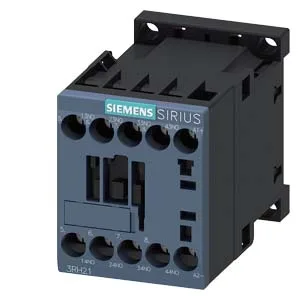
The Siemens SIRIUS 3RH2140-1MB40-0KT0 is a coupling relay for switching auxiliary circuits. The coil pulls 1.6 W to close and holds at 1.6 W. That matters when you're squeezing it into a crowded panel on a retrofit. Dimensions are 45 mm wide, 57.5 mm tall, 73 mm deep — it's a compact block that fits alongside S00 contactors in a common rail layout.
That's fast enough for most relay-logic and PLC-interposing duties, but if you're switching inductive loads, plan for the arc duration in your timing budget. DC switching is specified by pulse duration of 5 to 20 ms — a reminder that DC arcs don't self-extinguish like AC, so the relay is designed to clear quickly. Current ratings drop as voltage rises — a common derating curve for air-break contacts. At 24 V you get the full 10 A; at 230 V it's still 10 A; at 400 V it's 3 A; at 690 V it's 1 A. If you're using this relay to switch a control transformer primary at 400 V, the 3 A limit is the one to watch, not the headline 10 A number. Relative humidity minimum is 10 % — no upper limit stated, but the pollution degree 3 rating implies it can handle typical factory floor humidity without creepage issues.
Wire termination accepts 2x (0.5 to 1.5 mm²), 2x (0.75 to 2.5 mm²), or 2x 4 mm² solid or stranded. That's flexible enough for most control wiring — you can daisy-chain two conductors per terminal for commoning. The 4 mm² option lets you run a heavier feed wire if the relay is some distance from the power supply. These are the minimum air gaps to maintain for safe operation at rated voltage. In a dense panel, you'll want to respect the 6 mm side clearance to adjacent devices, especially if they generate heat or arc. The 3RH2140-1MB40-0KT0 does not have a built-in auxiliary switch extension — it's a bare 4-pole relay. If you need additional signaling contacts, you'll add a separate auxiliary switch block from the SIRIUS range. The product extension auxiliary switch field is marked 'No', so plan your feedback wiring accordingly.