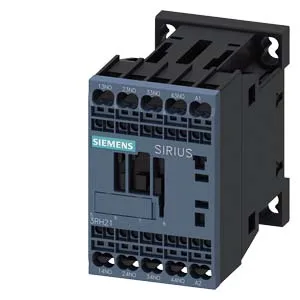
Rated for 10 A at both 24 V and 230 V, it handles typical control-circuit loads — PLC outputs, relay coils, indicator lamps — without derating at those common voltages. At 400 V the rating drops to 3 A, and at 600 V to 0.26 A, so it's not a power contactor; it's a control-circuit device.
Width is 45 mm, depth 73 mm, height 70 mm. The S00 footprint is compact — it fits in tight DIN-rail rows alongside other SIRIUS components. That's tight enough for dense panel layouts, but verify the 6 mm side gap isn't blocked by adjacent components or wire bundles. Terminals accept 2x (0.5 to 4 mm²) solid or stranded, or 2x (20 to 12 AWG). Screw-clamp type — strip length and torque per the datasheet, but the cross-section range covers most control wiring.
The 10 A rating at 24 V and 230 V is the continuous thermal current (Ith) — it's not a switching rating for motor loads. For inductive DC loads (relay coils, solenoids), the DC switching capacity at 24 V is 10 A, but at 60 V it drops to 4.7 A, and at 220 V to 1.2 A. That's typical for DC arcs — the contact gap and material limit the break current as voltage rises. Mechanical life is typical 30 million operations. That's the contactor body, not the contacts under load — actual electrical life depends on the switched current and load type. For dry-signal or low-current switching, it'll last the full mechanical life. That's the duration the arc sustains between contact separation and extinction. For control circuits with sensitive electronics downstream, ensure the PLC scan time or input filter is longer than 15 ms to avoid false triggering from the arc transient.