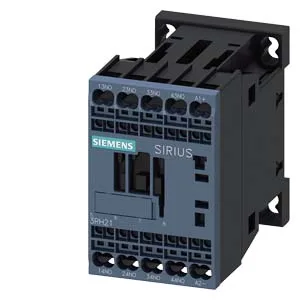
It's a signal-switching block, not a power contactor — it routes control signals and feedback from the main contactor or starter to the PLC or relay logic. The coil pulls in on 24 VDC nominal, with a closing power draw of 4 W. An integrated diode across the coil handles the flyback spike — no external snubber needed, but verify polarity before wiring: reverse the DC feed and the diode conducts, killing the coil supply.
The contact ratings are given per IEC utilization category at specific voltages. At 24 V rated value it switches 10 A; at 110 V rated value it drops to 3 A; at 220 V rated value it handles 1.2 A. These are resistive-load (AC-12 / DC-12) figures — inductive loads derate further. If you're switching a 24 VDC relay coil, the 10 A rating gives plenty of headroom; if you're piloting a 220 VAC contactor, the 1.2 A limit is the one to size against. Electrical life depends on the switched current and voltage; at the rated AC-15 / DC-13 values expect a fraction of that number. The arcing time spans 10 to 15 ms, which matters for timing coordination in safety circuits.
That covers most cabinet layouts without derating. Dimensions: 45 mm wide, 70 mm high, 73 mm deep — a compact S00 footprint. That's the minimum air gap to grounded metal for the rated insulation voltage; crowding it closer than that risks flashover at 690 V.
Compliance: RoHS substance prohibition date of October 1, 2009, so it meets the EU RoHS directive.