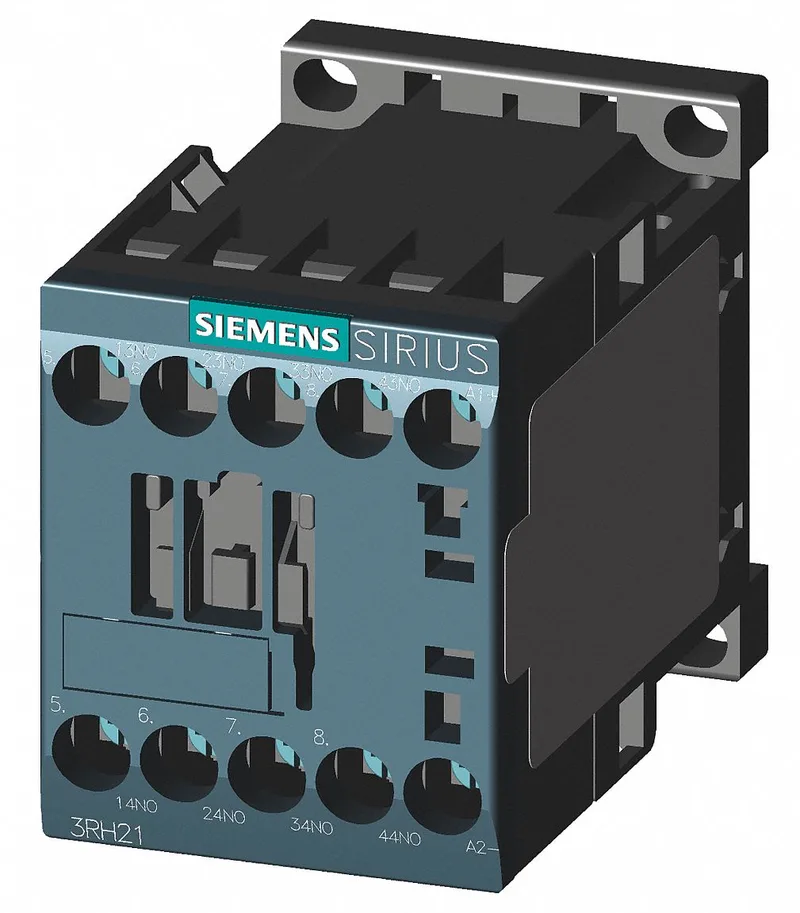
It mounts via screw or snap-on onto a 35 mm standard mounting rail, with a footprint of 73 mm deep, 45 mm wide, and 57.5 mm tall — a compact envelope that fits into crowded DIN-rail panels alongside contactors and overload relays of the same S00 family. Pollution degree 3 and a surge voltage resistance rated at 6 kV mean it's built for industrial control panels where transient spikes from inductive loads are the norm, not the exception. The operating range of -25 to +60 °C covers most ventilated enclosure environments, and the mounting position is flexible — ±180° rotation on a vertical surface, plus ±22.5° tilt forward or backward — so it adapts to tight layout constraints without derating.
What the contact ratings mean for your circuit
The 4 NO contacts are rated for breaking at specific voltages, not a single blanket current. At 230 V AC the contacts handle 10 A; at 400 V AC they break 3 A; at 690 V AC they break 1 A. For DC circuits, the 24 V rated value is 10 A, dropping to 4.7 A at 60 V, 3 A at 110 V, 1.2 A at 220 V, and 0.5 A at 440 V. This voltage-dependent derating is typical for DC switching where arc extinction is harder — match your control voltage to the row that covers your load current, not the highest number on the table. The closing and holding power of the DC magnet coil is 4 W steady.
Clearance, arcing, and switching frequency
The auxiliary switch extension capability (Product Extension Auxiliary Switch: Yes) means you can add a front-mounted auxiliary block later without swapping the base unit. The 0.8 initial value and 1.1 full-scale value likely refer to the contact force or pick-up/drop-out ratio.