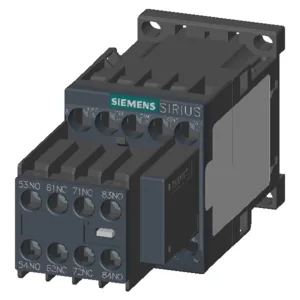
Panel fit and mounting — size S00, 45 mm wide
The 3RH2344-1DW40-0KA0 is a size S00 auxiliary contactor from the Siemens SIRIUS family, meaning it fits the compact footprint for control-circuit switching in motor starter assemblies and distribution panels. At 45 mm wide and 117 mm deep, it occupies a single 45 mm DIN-rail slot — the same pitch as a standard miniature circuit breaker, so no extra rail space is needed when grouping control devices. Mounting is via screw or snap-on onto a 35 mm standard mounting rail, with the option to rotate ±180° on a vertical surface or tilt ±22.5° forward/backward — useful when the panel layout forces an unconventional orientation. Clearance distances are tight: 10 mm upwards/forwards/downwards and 6 mm at the side, so adjacent devices can be packed close without derating.
Contact ratings across the voltage band — what the numbers mean
This auxiliary contactor carries 4 NO instantaneous contacts rated for switching across a wide voltage range. At 24 V the contacts handle 10 A; at 230 V they're rated 6 A; at 400 V it drops to 3 A; and at 690 V it's 1 A. The 0.26 A rating at 600 V and 0.5 A at 440 V show the AC-15 utilization category limits for inductive loads — these are the values that govern real-world solenoid and contactor coil switching, not the higher resistive ratings. The mechanical endurance is 10 million operations typical, with a maximum switching frequency of 10,000 cycles per hour at AC. For DC switching, the arcing time runs 7 to 13 ms — the built-in varistor surge suppressor clips the inductive kick, extending contact life on DC coil circuits.
Environmental range and compliance — panel-ready specs
Operating temperature spans -25 to +60 °C, with storage range from -55 to +80 °C and a minimum 10% relative humidity floor. Pollution degree 3 means it's rated for conductive environments typical of industrial control panels — no additional conformal coating required for standard factory air. RoHS compliance date is 07/01/2006, and the coil draws 4 W closing power at DC — a low enough burden for PLC digital outputs or relay contacts to drive directly without an interposing relay.