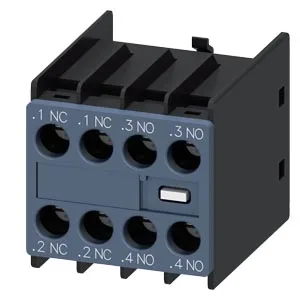
What this auxiliary switch block does on a 3RH2 contactor relay
The 3RH2911-1HA22-ZW98 is a front-mounted auxiliary switch block designed for Siemens SIRIUS 3RT2 contactors and 3RH2 contactor relays. It adds 2 normally-open and 2 normally-closed auxiliary contacts to the base device, giving you four additional signal or control paths without expanding the panel footprint. Snap-on mounting means it clips directly onto the front of the contactor or relay — no tools, no extra DIN rail slots. The assembled height stays at 37.5 mm, width 36 mm, depth 43.7 mm, so the overall stack fits within the standard contactor envelope.
Current ratings across the voltage range — what they mean for your control circuit
The maximum thermal current is 10 A, but the actual switching capacity depends on the circuit voltage and load type. At 24 V AC-15 duty it handles 6 A; at 230 V the same 6 A holds, while at 400 V it drops to 3 A, and at 690 V to 1 A. These are the values that govern whether this block can switch your specific pilot load — a PLC input, a contactor coil, or a signal lamp — without welding contacts. For DC circuits the numbers are lower: 10 A at 24 V, 4.7 A at 60 V, 3 A at 110 V, 1.2 A at 220 V, 0.5 A at 440 V, and 0.26 A at 600 V. If your application involves DC solenoid valves or indicator loads, use the DC column — the AC rating will not hold under DC arcing conditions.
Mechanical life and contact reliability — stocking for MRO
Rated for 10 million mechanical switching cycles typical, this is a fast-moving spare for any panel using 3RT2 or 3RH2 devices. The contact reliability spec — one faulty switching per 100 million operations at 17 V, 1 mA — means it handles low-energy signal circuits (like PLC inputs) without intermittent opens.
Panel integration notes — IP20 and surge withstand
IP20 on the front means the terminals are finger-safe but the block is not sealed against dust ingress — mount it inside an enclosure rated for the environment. The rated surge voltage resistance is 6 kV, so it can be used in circuits with moderate transient exposure without external suppression. Insulation voltage is 690 V AC at pollution degree 3, which covers standard industrial panel conditions where conductive dust or humidity may be present. The 2 NO + 2 NC contact arrangement gives you one NO and one NC on each of two current paths, per the factory wiring scheme.