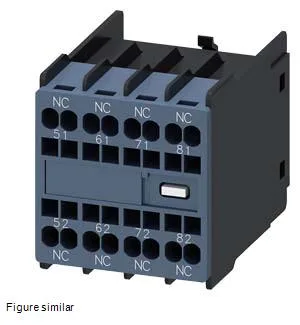
What this block does in the panel
The Siemens SIRIUS 3RH2911-2GA04-ZW97 is a front-mounted auxiliary switch block that adds four normally-closed (NC) contacts to a 3RH2 contactor relay. It snaps onto the DIN rail alongside the relay and connects via spring-loaded terminals — no screw torque to check, which speeds up panel wiring. The four NC paths are labeled 51/52, 61/62, 71/72, and 81/82, matching the standard auxiliary contact numbering for control circuits. Rated for 10 A thermal current (AC-1), it handles the control-circuit loads you'd expect: 6 A at 24 V, 6 A at 230 V, 3 A at 400 V. For AC-15 inductive duty at 690 V it's rated 1 A — enough for pilot duty on contactor coils and solenoid valves in a motor control center. The block is physically coded — it only mounts on 3RH2140 and 3RH2440 contactor relays per EN 50011. That means it won't accidentally fit a different frame size, which is a deliberate constraint to prevent miswiring during commissioning.
Dimensions are 36 mm wide, 41.5 mm tall, 47.7 mm deep — standard footprint for SIRIUS auxiliary blocks, so it fits alongside other 3RH2 accessories without crowding the enclosure depth. Spring-loaded terminals accept 2x (0.5... 2.5 mm²) solid or 2x (0.5... 1.5 mm²) with ferrule. AWG equivalent is 2x (20... 14). No special tool needed beyond a ferrule crimper if you're using stranded wire.
The pack quantity is 100 units. No obsolescence risk to manage on this code.
The 10 A thermal rating is the continuous current each contact path can carry in resistive load. The AC-15 ratings at different voltages tell you the inductive switching capability: 10 A at 24 V, 4.7 A at 60 V, 3 A at 110 V, 1.2 A at 220 V, 0.5 A at 440 V, 0.26 A at 600 V. These are the numbers that matter for contactor coil and small motor pilot duty — the AC-15 curve drops as voltage rises because of arc energy. Mechanical life is 10 million switching cycles typical, so the block outlasts most contactor relays it's paired with. That puts it in the same insulation class as the contactor relay it mounts on — no weak link in the control circuit isolation. The storage range is wider because the block isn't dissipating heat when stored — that limit governs shipping and warehouse conditions, not panel ambient.