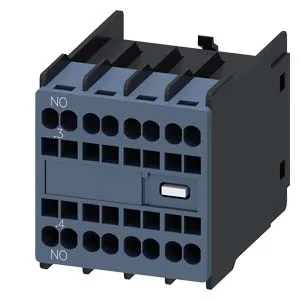
It snaps onto the front of 3RT2 power contactors and 3RH2 contactor relays, adding a single NO auxiliary contact path without increasing the device footprint on the DIN rail.
The 10 A rated value at 24 V is the continuous thermal current (Ith) for the auxiliary contact — it governs the maximum load the contact can carry in a control circuit at that voltage. For AC-15 inductive load switching at 690 V, the contact is rated 1 A, which is the figure that matters for pilot-duty applications like contactor coils or solenoid valves on a 690 VAC control bus. The insulation voltage is 690 V with pollution degree 3, confirming the contact block is rated for the same line-to-line voltage as the base contactor — no derating needed for the auxiliary circuit in a standard industrial panel. Surge voltage withstand is 6 kV, which aligns with IEC 60947-1 overvoltage category III for fixed-installation control gear.
The auxiliary contact's switching capacity varies with voltage: 6 A at 24 V, 6 A at 125 V, 6 A at 230 V, 6 A at 250 V, 3 A at 400 V, and 0.3 A at 220 V. The 0.3 A figure at 220 V appears anomalous against the 6 A at 230 V — trust the 230 V rating for 220 V line applications, as the 230 V value is the standard IEC rated operational current for that voltage class. At DC voltages the ratings are lower: 4.7 A at 60 V, 3 A at 110 V, 1.2 A at 220 V, 0.5 A at 440 V, and 0.26 A at 600 V. For a 24 VDC PLC output driving a contactor coil, the 6 A DC rating leaves ample headroom.
Mechanical endurance and contact reliability
Mechanical service life is 10 million switching cycles typical — this is the unloaded mechanical endurance, meaning the spring mechanism and snap-action contact will survive that many operations before wear affects the switching precision. That low-energy reliability figure is critical for direct connection to a 24 VDC PLC input: the contact must reliably pass the PLC's sense current (often 2-5 mA) without oxide-film buildup. The 1 mA threshold confirms it will.
Mounting and wiring integration
Snap-on mounting means the block clips directly onto the front of the base device — no tools, no DIN-rail space consumed beyond the contactor's own width of 36 mm. The spring-loaded terminals accept 2x (0.5 to 2.5 mm²) without wire ferrules, or 2x (0.5 to 1.5 mm²) with ferruled ends. AWG equivalents are 2x (20 to 14) for the auxiliary contacts. Depth is 47.7 mm, height 41.5 mm — the block protrudes forward from the contactor face by that depth, so verify clearance to the enclosure door or next device row.