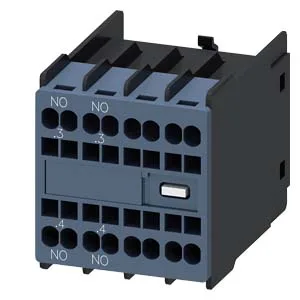
It provides two normally open (2 NO) instantaneous contacts, wired via spring-loaded terminals that accept 2x (0.5 to 1.5 mm²) with ferrule or 2x (0.5 to 2.5 mm²) solid, or 2x (20 to 14 AWG). The snap-on fastening method means it clips directly onto the contactor front without tools, adding no extra DIN-rail width — useful when panel fill factor is tight.
The headline ratings here are the contact current values across different voltages and duty categories. At 24 V the contacts are rated 10 A, dropping to 6 A at 230/250 V AC and 3 A at 400 V — these are the thermal current limits for general-purpose switching. For inductive loads under AC-15 duty (solenoid valves, contactor coils), the rating is 1 A at 690 V, which is the figure that governs most control-circuit applications in 400/480 V panels. Mechanical life is 10 million switching cycles typical, and contact reliability is specified as 1 faulty switching per 100 million operations at 17 V, 1 mA — that's the gold-plated low-level signal reliability figure, important if this switch carries PLC inputs or safety circuit feedback at low voltage.
Deployment context
This block snaps onto the front of a SIRIUS 3RT2 contactor or 3RH2 contactor relay, so it adds no additional panel width — the existing contactor's DIN-rail footprint stays unchanged. The spring-loaded terminals save wiring time compared to screw terminals, and the IP20 front protection means it's suitable for enclosed panels where no one touches live parts.