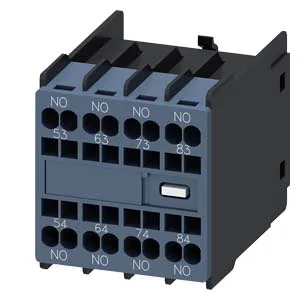
The Siemens SIRIUS 3RH2911-2XA40-0MA0-ZW97 is a front-mount auxiliary switch block designed for the 3RT2 power contactor and 3RH2 contactor relay families. It provides four normally-open (4 NO) auxiliary contacts in a single 36 mm wide housing that snaps onto the front of the base device — no extra DIN rail space required. The spring-loaded terminals accept 2x (0.5...1.5 mm²) with ferrule or 2x (0.5...2.5 mm²) solid, and the IP20 front protection means it lives inside the panel, not on the machine face. The contact arrangement is four independent NO paths (53/54, 63/64, 73/74, 83/84), each rated for 10 A maximum. That 10 A figure is the thermal current rating — what the contacts can carry continuously in free air. The real switching capacity depends on voltage and load type: at 24 V it switches 6 A (AC-15), at 230 V it still handles 6 A, and at 400 V it drops to 3 A. For DC loads, the ratings are lower — 10 A at 24 V, 4.7 A at 60 V, 0.5 A at 440 V — reflecting the harder arc extinction on DC.
The AC-15 rating at 690 V (1 A) tells you this block is certified for electromagnetic load switching — contactor coils, solenoid valves, small transformers — at the higher end of the voltage range. The 6 kV surge voltage resistance means it can handle the transient spikes common on 400 V industrial networks without welding or degrading the contacts. Insulation is rated for 690 V AC at pollution degree 3, which covers most factory-floor environments where conductive dust or humidity is present. That matters when you're using these contacts to switch PLC inputs or low-voltage sensor signals — dry-switching conditions where oxide films on standard contacts can cause intermittent failures. The SIRIUS block is designed for that regime, so it won't ghost-fault on a 24 VDC input card. That's the mechanism, not the electrical endurance — actual contact life under load will be lower depending on switching frequency and inrush current, but the base mechanical figure gives you a floor for preventive replacement intervals on high-cycle applications like conveyor interlocks or press controls.
Snap-on mounting to the front of the 3RT2 or 3RH2 base device — no tools needed, no DIN rail consumed. The block adds 47.7 mm depth and 36 mm width to the assembly, with a height of 41.5 mm. Spring-loaded terminals: strip 8 mm, push the orange actuator, insert the wire, release. Accepts 2x (0.5...1.5 mm²) with ferrule or 2x (0.5...2.5 mm²) solid, or 2x (20...14 AWG). The leading and lagging contact timing is zero — all four NO contacts close and open simultaneously, so no sequencing between them.