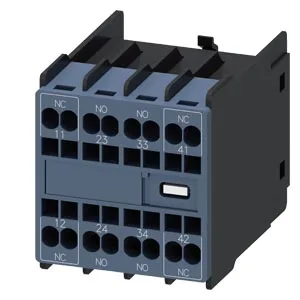
It provides 2 normally open and 2 normally closed contacts, with two of the NC contacts explicitly rated as solid-state compatible — meaning they can reliably switch low-level logic signals from a PLC or safety relay without the contact wetting issues that plague standard auxiliary contacts. The spring-loaded terminals accept 2x (0.5 to 1.5 mm²) with ferrule or 2x (0.5 to 2.5 mm²) solid, and the snap-on mounting clips directly onto the contactor without tools.
Contact configuration and solid-state compatibility — the detail that matters
The contact arrangement is 2 NO + 2 NC, with the NC contacts on current paths 1 and 4 designated as solid-state compatible (paths 11/12 and 41/42). The NO contacts on paths 23/24 and 33/34 are standard. The solid-state compatible designation means the contacts are gold-plated or otherwise treated to maintain a reliable connection at the low voltage and current levels typical of electronic inputs — 17 V, 1 mA is the stated reliability test condition, with a failure rate of 1 faulty switching per 100 million operations. This is critical when the auxiliary switch feeds a PLC input card or safety module rather than directly switching a contactor coil.
Current ratings across voltage and duty
The block carries a maximum thermal current of 10 A. For DC switching at 24 V it handles 6 A (resistive) or 10 A (rated value), dropping to 0.3 A at 220 V DC and 0.26 A at 600 V DC. For AC-15 control circuit duty at 690 V it is rated 1 A. The 10 A maximum is the thermal current — the actual switching capacity depends on voltage and load type, so match the specific curve for your application.
Mechanical life and environmental limits
Mechanical service life is typical 10 million switching cycles. The block measures 36 mm wide, 47.7 mm deep, and 41.5 mm high.