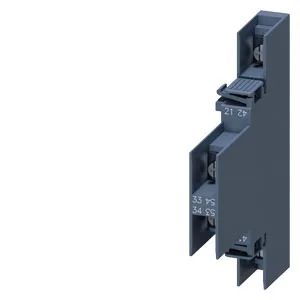
It snaps onto the front of a 3RH2140 or 3RH2440 auxiliary switch base, adding one normally open instantaneous contact to the assembly. The ring terminal lug connection means you're landing field wiring under screw terminals with ring lugs — common in North American panel practice where spade terminals aren't trusted under vibration. Rated for 10 A at AC-12 (resistive loads) and 1 A at AC-15 at 690 V (solenoid/contactor coil loads), the contact reliability spec is one faulty switching per 100 million operations at 17 V, 1 mA — that's dry-circuit territory, meaning it handles PLC-level signals without needing gold plating.
Snap-on mounting onto the S00 contactor relay front — no tools, no DIN rail. The 36 mm width matches the S00 footprint, so it doesn't steal panel space beyond the contactor's own width. Dimensions are 43.7 mm deep by 36 mm wide by 37.5 mm tall. The 6 kV rated surge voltage resistance (impulse withstand) means it's coordinated for 400 V industrial environments where switching transients are the norm.
The auxiliary contact carries 6 A at 24 V, 2 A at 48 V and 60 V, 1 A at 110 V, 0.9 A at 125 V, 0.3 A at 220 V and 250 V, and 3 A at 400 V. These are thermal current ratings for the contact block itself — the actual switching capacity depends on the load type (AC-12, AC-15, DC). The 10 A AC-12 figure is the maximum thermal current; the AC-15 rating at 690 V drops to 1 A because inductive loads with inrush stress the contacts harder. For DC switching, the ratings are 10 A at 24 V, 4.7 A at 60 V, 3 A at 110 V, 1.2 A at 220 V, 0.5 A at 440 V, and 0.26 A at 600 V. DC arcs are harder to extinguish than AC, so the derating is steep as voltage climbs. If you're switching a DC solenoid at 110 V, stay under 3 A.