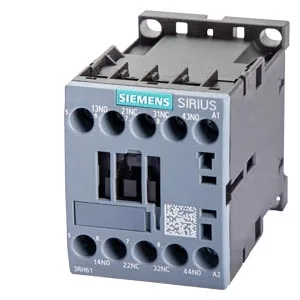
It carries a 48 VDC coil and four normally open (4 NO) contacts, identified as switching element code 40 E. The 48 VDC control supply voltage means this relay is intended for DC-powered control panels, not AC coil circuits. That's the difference between a relay that works for years and one that gets swapped every six months on a pick-and-place line.
That's useful when you're squeezing this into a tight gland-plate area and need to angle the block for wire access. Dimensions are 45 mm wide, 57.5 mm tall, 73 mm deep — fits the standard S00 footprint. Screw-type terminals for the auxiliary and control circuits accept 2x (0.5 to 1.5 mm²), 2x (0.75 to 2.5 mm²), or 2x 4 mm² solid/stranded, plus the AWG equivalents. Finely stranded wire needs core-end processing (ferrules).
The 4 NO contacts are rated for different currents depending on the voltage and load type. At 24 V the contacts switch 6 A; at 110 V it's 3 A; at 220 V it's 1.2 A; at 230 V it's 10 A; at 400 V it's 3 A; at 690 V it's 1 A. The 230 V figure (10 A) likely reflects a resistive AC-12 load, while the lower values at higher voltages reflect the arc-quenching limits of the contact gap. For DC-12 and DC-13 loads, the maximum operating frequency is 1 000 switching cycles per hour.
That's a long service life for a panel relay — you're not replacing this every year on a conveyor line.
Installation altitude is limited to 2 000 m above sea level without derating. The substance prohibition date of 05/01/2012 aligns with RoHS compliance — this relay meets the EU RoHS directive for lead, mercury, and other restricted substances. That's a continuous-duty coil — no need for a separate holding-current economizer circuit.