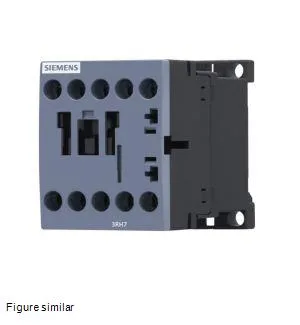
The 3RH7140-1AG00 is a Siemens SIRIUS contactor relay in the S00 frame size, carrying 4 normally-open auxiliary contacts (configuration 40 E) and an AC-operated coil. It's a current-production part, so the BOM line is stable for new builds and spares alike.
The 4 NO contacts are rated for switching at several common control voltages: 6 A at 24 V, 110 V, 230 V, and 400 V AC; 1 A at 690 V AC; and 0.3 A at 220 V AC. The contacts are rated for PLC-level reliability down to 17 V, 5 mA — that's the 'acceptability for PLC control' spec. It means the silver-alloy contacts are designed to switch dry logic-level signals without the oxide-film issues that plague standard power contacts at low energy. If you're feeding a 24 V DC digital input card, these won't give you a phantom open. Coil draw is 27 VA pick-up, 5.4 VA holding at AC, power factor 0.8 and 0.27 respectively. That holding VA is low — about 45 mA at 120 V — so the PLC output driving it sees a light load once the relay seals in. The 7 kV surge voltage resistance means the coil withstands common-mode transients on a dirty line without flashover. Insulation is rated 690 V AC at pollution degree 3, so it's suited for 480 V panels where the environment isn't climate-controlled.
The S00 footprint is compact — 45 mm wide, 72 mm deep, 57.5 mm tall — so it fits in a crowded panel without hogging the DIN rail. That helps when the gland plate forces an odd orientation. Screw terminals accept 2 x 0.5 to 1.5 mm² solid or stranded, or 2 x 0.75 to 2.5 mm², or a single 4 mm². That's enough for a daisy-chain through the auxiliary contacts without piggyback terminals. Finely stranded wire with ferrules is also supported at the same ranges. The product extension for auxiliary switches means you can add a side-mount block later if 4 NO isn't enough — the base relay already carries the mechanical interface for it.
Operating temperature is -10 to +55 °C; storage from -25 to +70 °C. Installation altitude is limited to 2 000 m above sea level — above that, derate the insulation or use a higher-voltage class relay. Shock resistance is 15g / 5 ms and 8g / 10 ms for sine pulse; 10g / 5 ms and 5g / 10 ms for rectangular impulse. That's typical for a relay that might live on a machine frame near a press or conveyor impact zone. The DC-13 operating frequency maxes at 1 000 operations per hour — about one cycle every 3.6 seconds, which is fine for most PLC-driven sequences.