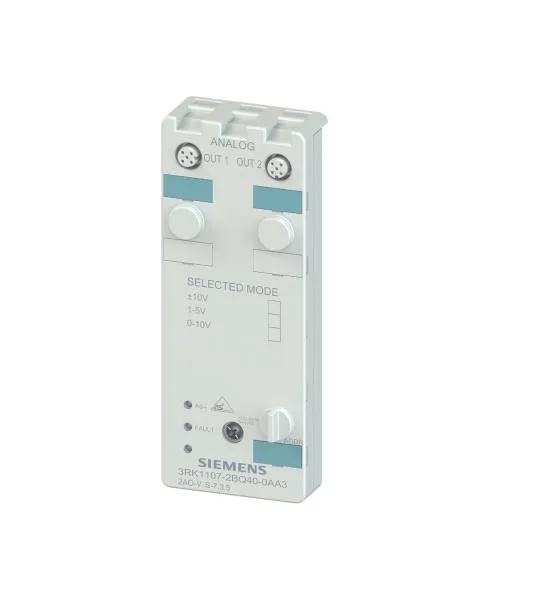
The Siemens 3RK1107-2BQ40-0AA3 is an AS-Interface compact module from the K60 family — an analog output module for voltage values, designed to sit out in the field rather than inside a control cabinet. It gives you two analog voltage outputs, each configurable for ±10 V, 0 to 10 V, or 1 to 5 V ranges, driving up to 30 mA per actuator. That makes it the piece that takes a digital AS-i bus command and turns it into a real voltage signal for a valve positioner, a variable-speed drive setpoint, or a proportional regulator. The module is an analog AS-Interface slave, drawing its power straight from the AS-i cable at 26.5 to 31.6 V. Maximum current draw from the profile conductors at 30 V is 160 mA, so it won't overload a standard AS-i power supply even on a populated segment. The 12-bit resolution on the analog outputs gives you about 4.9 mV per step on the 0–10 V range — enough granularity for most process setpoints without overshooting the loop.
Built for the grease, not the cabinet
Rated IP67, this module is sealed against dust and water jets — it belongs on a machine frame, a conveyor leg, or a washdown station, not behind a panel door. The housing is the K60 compact form factor: 152 mm tall, 60 mm wide, 29 mm deep. That footprint is meant for standard rail mounting or wall mounting using a separate mounting plate (3RK1901-0CA00, ordered separately). Connections to the outside world go through M12 screw-type terminals — the standard fieldbus connector for sensors and actuators in wet or dirty environments. The two voltage outputs each get their own M12 socket, and the AS-i bus comes in through a separate M12 connection. On the module face you get a green LED for AS-Interface communication status and a red LED for fault indication. The ID code is set to 3 and the I/O configuration to 7 — these are the AS-i profile settings that tell the master what kind of slave it's talking to.
The mounting plate 3RK1901-0CA00 is a separate order line — make sure it's on the BOM if you're mounting to a flat surface rather than DIN rail. The module itself clips onto the plate, which then screws to the machine frame. Temperature range covers -20 to +60 °C during operation and -40 to +85 °C in storage — fine for most factory-floor environments short of a foundry or freezer tunnel.