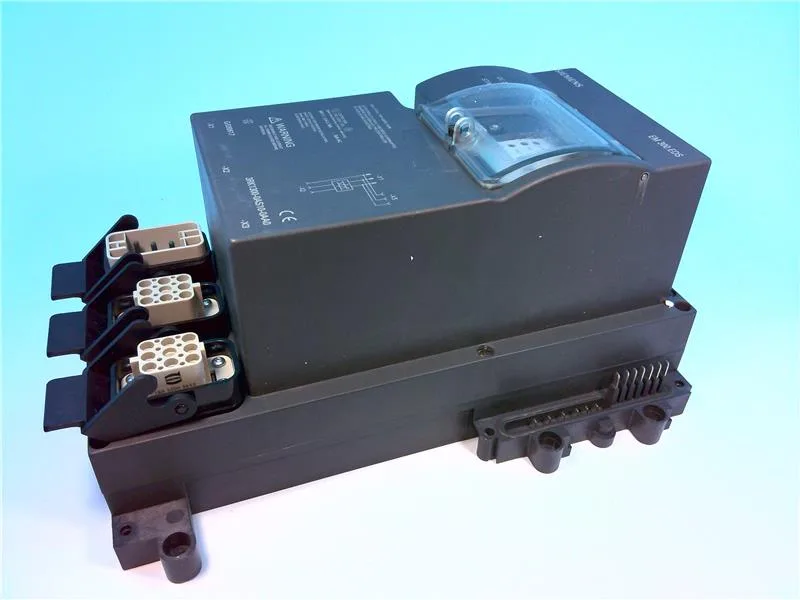
The Siemens 3RK1300-0ES01-0AA4 is an EM 300 DS electromechanical direct starter designed for the ET 200X distributed I/O system. It's a fully integrated motor starting and protection unit — not just a contactor, but a direct starter with bimetal overload protection built in, covering a setting range of 0.28 to 0.4 A. Rated at 0.1 kW at 400 V in AC-3 duty, this starter handles the switching and protection of small induction motors typical in conveyor drives, valve actuators, or pump stations on a distributed network.
The 0.28–0.4 A setting range paired with the bimetal overload matches motors drawing that full-load current. At 400 V AC-3, that's 0.1 kW — a small motor, likely a fractional-horsepower unit. Don't oversize it; the bimetal trip curve is calibrated to that window. Operating voltage range is 400 to 500 V, so it works on 400 V and 480 V nominal systems common in industrial plants. The DC control voltage type (0.28 A initial, 0.4 A full-scale) suggests a 24 VDC coil, though the exact coil voltage isn't stated — verify against your control supply. The integrated motor brake output is a key differentiator: this starter can directly control a DC-injected brake on the motor, saving an external brake rectifier and relay. The brake contact is rated DC 500 V / 1 A per the description. Short-circuit breaking capacity is 50 A at 400 V — that's the maximum fault current the integrated circuit-breaker-style protection can interrupt. In a real panel, ensure the upstream protective device limits let-through to 50 A or less.
PROFIBUS DP and system integration
This starter communicates via PROFIBUS DP, making it a smart device on the ET 200X backplane. The bus connection carries start/stop commands, fault status, and current monitoring back to the PLC without separate control wiring. The main current circuit uses tab terminals. Control and bus connections are via the 9-pole motor feeder and 9-pole power connector. Dimensions are 134 mm deep, 140 mm wide, 270 mm tall. That's a compact footprint for a fully integrated starter with brake output and bus interface.