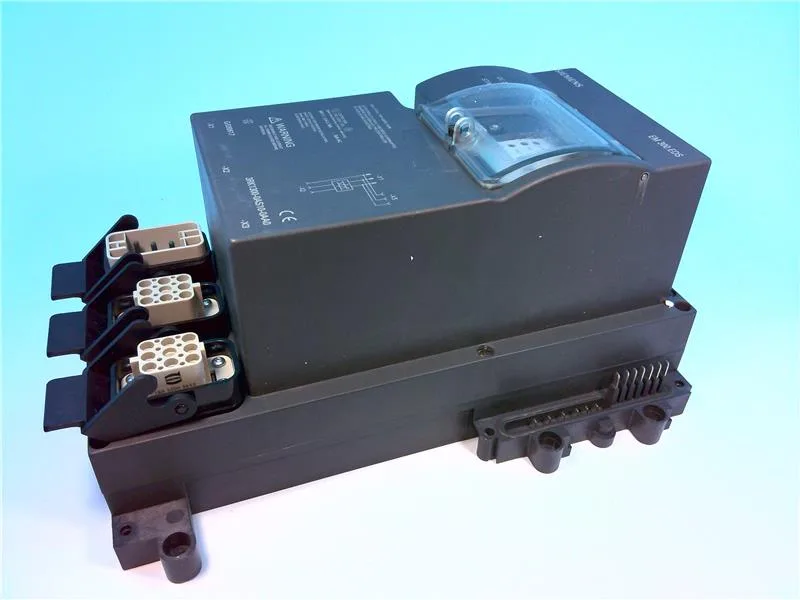
The Siemens 3RK1300-0FS01-1AA4 is a SIRIUS reversing starter from the ET 200X family — an electromechanical motor starter that handles forward/reverse control of a small motor in one compact, IP65-rated enclosure. It is designed for distributed automation architectures where the starter mounts directly on the machine, not in a central panel. The setting range of 0.35...0.5 A covers small motors up to 0.12 kW at 400 V in AC-3 duty, which is the standard category for squirrel-cage induction motors under normal starting conditions. The bimetal overload protection trips on motor heating, not just instantaneous current, so it tracks the thermal state of the motor winding. PROFIBUS DP onboard means this starter communicates directly with a PLC without a separate gateway — the bus cable runs to the unit, and the starter handles its own I/O mapping for start, stop, direction, and fault feedback. The integrated brake output (DC 500 V / 1 A) supplies an external motor brake, which is typical for holding loads on conveyors or vertical axes.
IP65 and machine-mount deployment
The operating temperature range of 0 to 55 °C covers most factory-floor conditions, but below 0 °C the bimetal trip curve shifts — if the starter is in a refrigerated area, the ambient rating is the limit.
Short-circuit coordination and selectivity
This is a Type 1 coordination figure — upstream protection (circuit-breakers, per the design) must limit the let-through energy to keep the starter repairable after a fault.