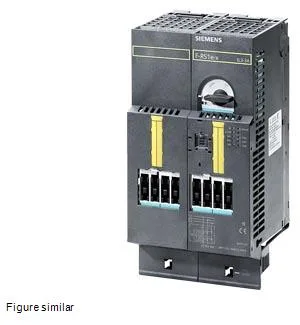
The Siemens SIMATIC 3RK1301-0CB13-1AA2 is a reversing motor starter designed for 24 V DC control, rated to interrupt 50 kA at 400 V — built for the pit, not a clean room. It handles reversing and direct-start loads in crusher, conveyor, and pump applications where vibration and dust ingress are daily reality. The 5g / 11 ms shock resistance and 2g vibration rating mean it shrugs off the shaking from a nearby crusher without nuisance trips. The part is a SIMATIC-branded motor starter with a reversing starter design — it can reverse motor direction without external contactors. It plugs onto a terminal module for quick swap-out, saving panel space at 130 mm wide, 290 mm tall, 150 mm deep. The 2-byte input and 2-byte output process data map directly to a PROFINET or PROFIBUS DP controller, so wiring is just the power and the network cable.
If your SCCR calculation needs that number, this part delivers it without an upstream current-limiting fuse. The adjustable trip class lets you set Class 10 for fast protection on short-rotor-time motors (conveyors, crushers) or Class 20 for longer acceleration profiles (fans, centrifuges). That adjustability means one part covers both duty types, reducing spare-part count. MTBF of 11 a and MTTFd of 31 a are the reliability figures for a continuous-duty line. The MTTFd of 31 a means the dangerous failure rate is low enough for SIL applications per IEC 61508. Safe state is load circuit open — when the safety function trips, the output contacts open and the motor coasts to stop. Maximum operating frequency is 80 cycles per hour, so this is sized for industrial cycling, not high-speed indexing. Degree of pollution 3 at 400 V means it's rated for conductive dust and occasional condensation — exactly what you get in a mineral-processing plant. The 24 V DC control supply is standard for PLC-driven panels; the supply voltage range is 21.6 to 26.4 V DC, with maximum permissible 28.8 V and minimum 20.4 V. That gives you headroom for voltage drop on long cable runs.
Mounting is pluggable on a terminal module — the base unit snaps onto a DIN-rail-mounted terminal block, so swapping the electronics leaves the wiring undisturbed. Mounting position is vertical or horizontal, giving layout flexibility in a crowded enclosure. The screw-type terminals for main energy infeed accept standard ring lugs.