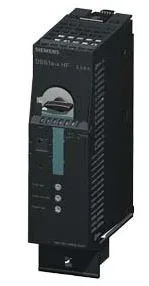
This is a Siemens SIMATIC SIRIUS 3RK1301-0CB20-0AB4 direct-on-line motor starter — a self-contained unit that combines a contactor, overload relay, and fieldbus interface into one package. It sits on a terminal module via pluggable connection, so you mount the base wiring once and swap the control module without touching the power terminations. It's built for motor control in distributed automation schemes — think conveyor sections, pump stations, or small machine cells where you want PROFINET or PROFIBUS DP right at the motor starter rather than running individual control wires back to a central cabinet.
The adjustable trip class — Class 10 and 10A — is what decides whether this starter protects your motor during a stall or start. Class 10A is a tighter band, tripping faster, meant for motors with short acceleration times or where you need closer thermal protection. You set it via a rotary dial on the module. Pollution degree 3 at 400 V and degree 2 at 500 V (per IEC 60664 / IEC 61131) means the creepage and clearance distances are designed for conductive dust or occasional condensation — typical inside an unsealed panel in a factory environment. At 500 V you need a cleaner environment (degree 2) to maintain the same insulation margin.
The starter snaps onto a terminal module — the screw-type terminals for the main power infeed stay on the base, so you can pull the control module for service or replacement without disturbing the motor cables. The energy bus on the backplane daisy-chains power to adjacent starters in the same row, saving a terminal per unit. It mounts in any orientation — vertical or horizontal — and its footprint is 65 mm wide by 150 mm deep by 290 mm tall. That's a narrow slice of DIN rail, leaving room for other components in a crowded enclosure. The 24 V DC control supply has a range of 20.4 to 28.8 V, so it's tolerant of a sagging bus but not a 12 V system. Two digital inputs are available on the control module for local pushbuttons or limit switches, and the I/O mapping gives you 2 bytes each for inputs and outputs over the fieldbus — enough for start/stop, fault feedback, and a couple of status bits.