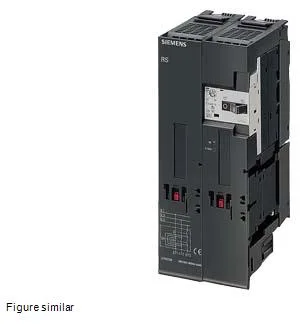
The Siemens SIMATIC 3RK1301-0FB00-1AA2 is a reversing motor starter from the ET 200pro family, designed for distributed motor control in automated lines. It integrates a reversing contactor, overload relay (Class 10 trip), and digital communication — PROFINET and PROFIBUS DP — into a single pluggable module that mounts on a terminal module. The 24 V DC control supply (20.4 to 28.8 V) powers the coil and the bus interface, while the main power circuit handles motor loads. This is not a standalone contactor; it is a functional block for a motor control center or a decentralized I/O station.
The operating frequency of 750 operations per hour (1/h) limits how often you can cycle the reversing contactor — fine for normal start/stop duty, not for high-speed jogging or indexing applications. The 24 V DC control voltage range (20.4 to 28.8 V) matches standard PLC or power-supply rails; the module will drop out below 20.4 V, so verify your DC bus stays within that window under load.
The module fastens by plugging onto a terminal module (screw-type terminals for the main energy infeed). It can be mounted vertically or horizontally. The enclosure dimensions are 265 mm high, 90 mm wide, and 120 mm deep — plan your DIN-rail or backplate layout accordingly. Vibration resistance is 2g continuous, shock resistance is 5g for 11 ms. Pollution degree is rated at 3 for 400 V and 2 for 500 V per IEC 60664 / IEC 61131, meaning it is suitable for industrial environments with conductive dust or light condensation, but not for submersion or heavy washdown.
Communication and I/O architecture
This starter communicates via PROFINET and PROFIBUS DP — it is a dual-protocol device, not a gateway or bridge. The module exposes 1 byte of input data and 1 byte of output data on the fieldbus, which is typical for a compact motor starter: the input byte carries status (running, fault, overload), and the output byte carries control (start forward, start reverse, stop). There are no onboard digital I/O terminals; the control signals are mapped through the bus. The type of assignment is 2, which in Siemens terminology means it is a reversing starter with two contactor paths (forward and reverse). The direct start function is not applicable here — reversing starters inherently use two contactors.