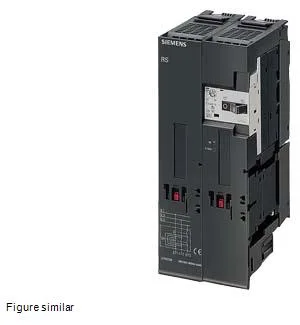
SIMATIC reversing starter, live on the line
The 3RK1301-1JB00-1AA2: Rated CLASS 10 trip, so it protects standard induction motors on start-up without nuisance tripping — the classic thermal curve for general-purpose motor starting. The reversing design allows two contactors in one package, saving panel width over a pair of separate contactors and a mechanical interlock.
Fieldbus and I/O — what it carries onboard
This starter has PROFINET and PROFIBUS DP protocol support on the control module, so it talks directly to a PLC backplane without an extra gateway. The I/O mapping is straightforward: 1 byte of inputs and 1 byte of outputs — enough for start/stop, direction, and feedback without tying up a remote I/O rack. No digital I/O is onboard (0 digital inputs, 0 digital outputs); all control comes through the fieldbus link. The starter itself has no direct-start capability (Direct Start: No), so it requires the fieldbus command or a separate control module to initiate. The brake control outputs are absent (no 24 V DC brake control, no 180 V DC brake control), so any brake solenoid needs its own contactor.
Dimensions and mounting — panel fit
The form factor is 265 mm high × 90 mm wide × 120 mm deep. It fastens by plugging onto a terminal module — no DIN-rail clips on the starter itself, so the base terminal block must be pre-wired on the rail, and the starter module snaps onto that. Mounting position is vertical or horizontal, which gives flexibility in tight enclosures. Operating temperature range is 0 … 60 °C; storage and transport handle -40 … +70 °C. Vibration resistance is 2g, shock resistance 5g / 11 ms — standard for industrial panel mounting, not rated for direct machine-mount without damping.
The main power infeed uses screw-type terminals — no spring-cage, so plan for a screwdriver on the line side. The supply voltage is 24 V DC nominal, with a minimum of 20.4 V and maximum of 28.8 V. Degree of pollution rated 3 at 400 V, 2 at 500 V per IEC 60664 / IEC 61131, which covers typical industrial environments with conductive dust or occasional condensation.