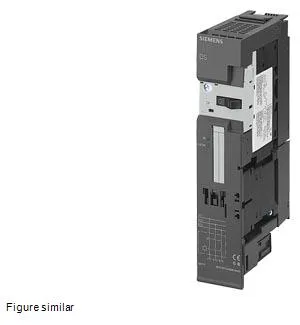
The Siemens SIMATIC 3RK1301-1KB00-0AA2 is a direct motor starter designed for motor control in automation systems. This unit communicates over PROFINET and PROFIBUS DP protocols, making it suitable for integration into Siemens S7 and other fieldbus-based control architectures. It provides 1 byte of input data and 1 byte of output data for status and control signals. Rated for a 50 kA short-circuit current at 400 V, it can be installed in high-fault-current panels without additional upstream current-limiting fuses in many configurations. The supply voltage is 24 V DC nominal, with a permissible range of 20.4 to 28.8 V DC.
The starter mounts by plugging onto a terminal module, not by direct DIN-rail clipping — the terminal module is the mechanical anchor. This means panel layout must account for the terminal module footprint first. Mounting position is flexible — vertical or horizontal — which helps when fitting into tight enclosures. Vibration resistance is 2g; shock resistance is 5g for 11 ms. The main power infeed uses screw-type terminals; control signals are handled via the pluggable connection to the terminal module. No digital inputs or outputs are built into this base unit — those come from a separate control module that plugs on top.
The 3RK1301-1KB00-0AA2 is a direct starter variant. If your application requires reversing, this specific order code does not support it — you would need a different variant. The maximum operating frequency is 750 cycles per hour, so it is suited for moderate-duty cycling, not high-speed indexing. Power dissipation is 4.118 W with bypass circuit active, 4.1184 W without — negligible for panel thermal calculations, but worth noting if you are packing multiple units in a sealed enclosure.