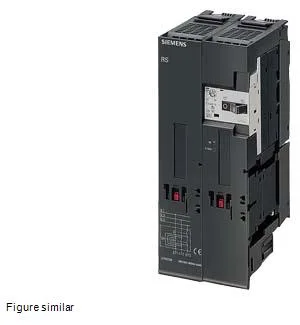
The Siemens SIMATIC 3RK1301-1KB00-1AA2 is a reversing motor starter — it handles forward-reverse duty for three-phase motors up to the CLASS 10 trip curve, meaning it will disconnect within 10 seconds under locked-rotor conditions, protecting both the motor and the downstream wiring. The 24 V DC control supply (20.4 to 28.8 V range) is standard for modern PLC-driven panels, and the unit communicates over both PROFINET and PROFIBUS DP, so it drops into either a Siemens S7 environment or a mixed-protocol line without a gateway.
This starter mounts by plugging onto a terminal module — no DIN-rail clip, no screw-down baseplate. That means the wiring stays in the panel while the control module swaps out in seconds, which is exactly what you want when a starter fails and the line is down. It sits in a 265 x 90 x 120 mm envelope (height x width x depth). The 90 mm width is three standard DIN-rail module slots (18 mm each), so it occupies a known footprint in a Siemens SIRIUS panel layout. Mount it vertical or horizontal — the spec allows both. Pollution degree 3 at 400 V and 2 at 500 V per IEC 60664 / IEC 61131 means it's rated for industrial environments with conductive dust or light condensation — typical for a factory floor panel.
With no digital I/O on-board (0 inputs, 0 outputs), all control signals come over the fieldbus. The reversing function is built into the starter itself, so you don't need an external contactor pair or interlock wiring — the PROFINET/PROFIBUS command handles forward/reverse logic. Shock resistance is 5g for 11 ms, vibration resistance 2g — tough enough for a conveyor line or a pump skid, but not rated for heavy crusher or press applications where you'd need a higher g-rating.