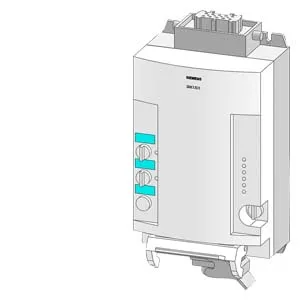
The Siemens 3RK1303-6ES81-3AA3 is an ECOFAST reversing starter with solid-state switching contacts and full motor protection, designed for multi-speed reversing applications up to 1.5 kW at AC-3 duty on a 400 V supply. The starter communicates over PROFIBUS DP, making it a direct node on a Siemens S7 or third-party master bus without an additional gateway. Two parameterizable speeds and eight derating factors are configurable over the bus, so speed changes and overload curves are set in software rather than by swapping heater elements.
The headline rating is 1 500 W operating power at AC-3 at 400 V — this is the motor load it can switch under standard induction-motor starting conditions (inrush, locked-rotor, and running). For a 1.5 kW, 400 V three-phase motor, the full-load current is roughly 3.2 A; the starter's 4 A full-scale value and 0.6 A initial setting cover that motor comfortably, with headroom for light overloads. The short-circuit protection is fuse-based, so the upstream fuse must be coordinated to clear before the solid-state output is damaged. DC supply voltage range is 400 to 500 V DC, which is unusual — this unit runs its internal logic and brake output from the DC bus, not a separate 24 V control supply. The motor brake output is integrated, saving an external brake rectifier for holding-brake motors. Ambient temperature range is -20 to +40 °C during operation. Above 40 °C the solid-state output must be derated; the eight configurable derating factors in the firmware handle that automatically once the ambient sensor input is set.
Envelope dimensions are 125 mm deep by 130 mm wide by 250 mm high. The main current circuit connects via tab terminals, which means the installer needs mating tab receptacles (typically 6.3 mm or 4.8 mm, depending on the current rating of the specific tab). The IP65 housing has cable glands for the PROFIBUS DP and power cables; no DIN-rail mounting — the unit is panel-mounted through its own fixing points. Because the switching contacts are solid-state, there is no coil hum, no contact bounce, and no arc wear — the unit is electrically silent in operation. The trade-off is a higher off-state leakage current than a mechanical contactor; verify that the downstream load (typically a motor contactor or direct motor) is compatible with that leakage.