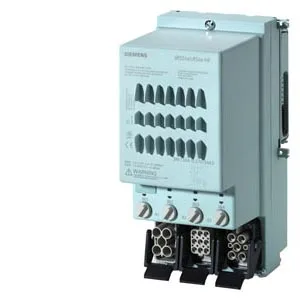
The Siemens SIMATIC 3RK1304-5KS70-3AA0 is a reversing motor starter with a bypass circuit, rated for direct-on-line starting at 400 V AC and 2 A. It carries a 100 kA SCCR at 400 V, so it can be installed on fault-current-capable distribution without requiring upstream current-limiting fuses for coordination. The IP65 enclosure means this unit lives on the machine, not in a clean panel — it takes washdown and airborne particulates common in food-and-bev or packaging lines.
Trip class is field-adjustable between CLASS 5, 10, 20, and 30. That range covers fast-acting protection for short-cyclic loads (CLASS 5) through slower curves for high-inertia starts (CLASS 30). The reversing contactor pair is built in — no external interlocking required for direction change, and the unit supports reverse starting natively. PROFINET and PROFIBUS DP are both on board, so this starter talks directly to a SIMATIC S7-1200 or S7-1500 controller without a separate gateway. The 2-byte input and 2-byte output process image carries status and control for the reversing pair. Four digital inputs are available via M12 socket for local pushbuttons or sensors.
Mounting is screw-fix to a backplate or machine frame — not DIN rail. The 230 × 110 × 160 mm (H × W × D) footprint fits a standard junction-box gland plate; plan for M20 or PG16 cable entries. Mounting position is vertical or horizontal, so it adapts to tight machine cavities. The supply voltage is 24 V DC nominal (20.4 to 28.8 V range), which matches standard control-voltage rails in most industrial cabinets. Power dissipation is 3.168 W with or without the bypass circuit engaged, so no special ventilation is needed in a sealed enclosure.
Environmental ratings: IP65 protects against hose-directed water and dust ingress. Shock resistance is 15 g for 11 ms, vibration resistance is 2 g — both within typical machine-mount expectations for conveyors, packaging equipment, and material-handling cells.