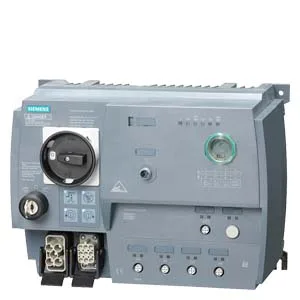
What this SIRIUS reversing starter is
It's a self-contained unit rated for 0.75 kW at 400 V, with a Trip Class 10 overload protection curve that trips within 10 seconds at 7.2× rated current — standard for protecting standard induction motors during start-up. The IP65 enclosure means the whole assembly is dust-tight and protected against water jets, so it can be mounted directly on machine frames or in washdown zones without a separate cabinet. Supply voltage is 24 V DC, with a permissible range of 20.4 to 28.8 V DC, which covers most industrial 24 V control buses.
The 0.75 kW rating at 400 V is the motor output it can switch in AC-3 duty — that's a standard 1 hp (0.75 kW) three-phase motor for small conveyors, pumps, or fans. At 460/480 V it's rated 0.7 hp, and at 575/600 V it's 1 hp, so it tracks the typical NEMA motor frame sizes. The Trip Class 10 rating means the overload relay will not trip during a normal start (typically under 10 seconds), but will protect the motor from sustained overloads. This is a reversing starter, meaning it can switch motor direction without external contactors — built-in interlocking prevents both directions from being energized simultaneously. Shock resistance of 12g at 11 ms and vibration resistance of 7 mm at 2g mean it survives the vibration from nearby machinery without nuisance trips.
Mounting and connectivity
Mounting is by screw fixing, with the unit measuring 294 mm wide, 215 mm high, and 159 mm deep. It can be installed in vertical, horizontal, or flat orientations, though horizontal mounting is recommended for optimal heat dissipation. The main circuit connects via a HAN Q4/2 plug according to ISO 23570, which is a standard industrial connector for motor power. Device addressing uses an M12 plug, and there are 4 digital inputs for control signals. Communication is via AS-Interface protocol — no PROFIBUS or PROFINET on this variant, so plan your fieldbus accordingly. On-delay time is 85 ms and off-delay is 65 ms — these are the response times for the starter to energize or de-energize after receiving the command signal. For most conveyor or pump applications these delays are negligible, but if you're sequencing high-speed pick-and-place operations, factor them into your timing budget.