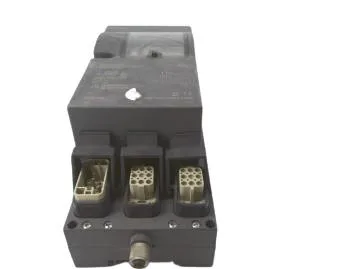
The Siemens 3RK1322-1FS02-1AA3 is an AS-interface compact reversing starter in an IP65-rated enclosure, designed for direct-on-line motor control in distributed automation layouts. It's an electromechanical reversing starter with bimetal motor protection, set for a current range of 3.5 to 5 A, delivering 1.9 kW at 400 V under AC-3 duty — that's the motor-switching rating, not the resistive load curve.
The 3.5 to 5 A setting range and 1.9 kW at 400 V AC-3 tell you this is sized for small three-phase motors — think fractional to about 2.5 HP at 400 V. The bimetal overload relay inside provides inverse-time thermal protection, so it tracks motor heating reasonably well for standard squirrel-cage induction motors.
AS-interface and bus integration
This starter communicates via AS-interface protocol, not PROFIBUS DP. The part includes bus communication capability and two integrated inputs, which means it can take direct commands from the AS-i master and also read local sensors (e.g., limit switches or presence detectors) without an extra I/O block. There's also a motor brake output built in — a 400 V AC brake contact for holding brakes on vertical-axis drives.
Physical layout and connection
Main circuit connections use tab terminals, which are common for quick-connect wiring in distributed installations. The motor outgoing feeder is a 9-pole connection, and the power connection is also 9-pole, so you're wiring a single multi-conductor cable for the motor, brake, and feedback.