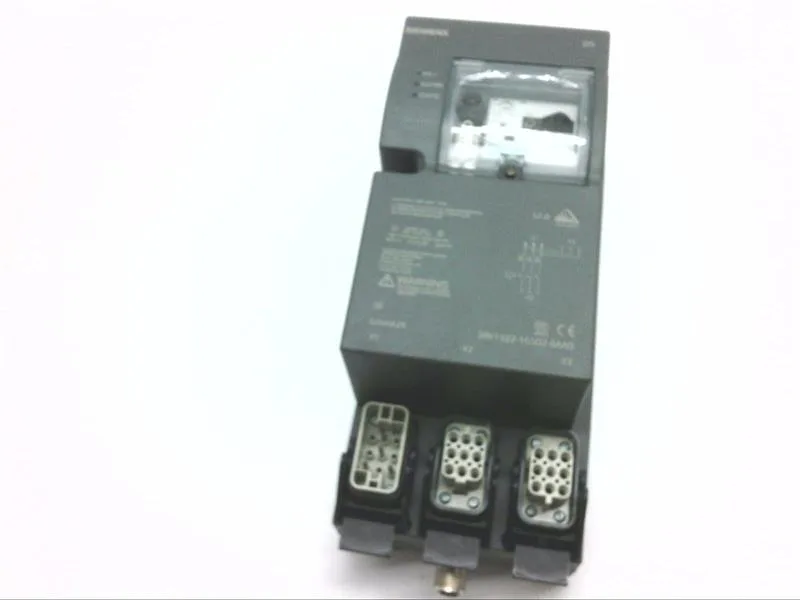
AS-i compact DOL starter for distributed motor control
The Siemens 3RK1322-1GS02-0AA1 is an AS-interface compact direct-on-line starter that combines a contactor, bimetal overload relay, and short-circuit protection (circuit-breaker type) in a single IP65 enclosure. The setting range of 4.5...6.3 A covers small motors up to 2.2 kW at AC-3 duty (400 V), and the integrated brake contact (24 V DC / 3 A) handles holding brakes on vertical-load axes or quick-stop applications.
The 2.2 kW rating at AC-3 (400 V) is the motor-switching capacity — it's sized for a 3 HP / 2.2 kW induction motor under full-load starting. The bimetal overload provides thermal motor protection, adjustable via the 4.5...6.3 A dial. The 24 V DC brake contact output (3 A) is separate from the main power circuit, so you can wire a spring-set brake directly without an interposing relay.
Deployment context: distributed motor control on AS-i
This starter communicates over AS-interface, so it's a node on an AS-i bus — no parallel control wiring needed. The 9-pole motor outgoing feeder and 9-pole power connection are tab terminals, matching standard AS-i flat-cable or round-cable drop connectors. Mount it directly on the machine frame; the IP65 enclosure handles washdown, so it's common on food-and-beverage conveyors, packaging lines, and material-handling systems where a central panel would be impractical. The two integrated inputs allow local sensors (e.g., limit switches or photo-eyes) to be wired back through the starter, reducing field wiring to one AS-i cable.