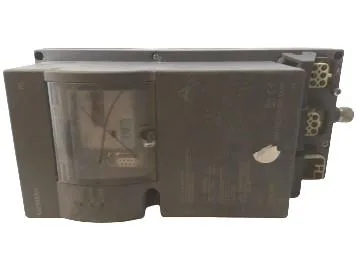
Reversing starter for motor control in washdown zones
The Siemens 3RK1322-1JS02-1AA3 is a reversing starter — a compact electromechanical unit that combines a contactor pair with bimetal overload protection for forward/reverse motor control. The IP65 enclosure means the entire assembly — contacts, bimetal relay, and wiring terminations — withstands hose-down cleaning and airborne dust, making it a fit for food-and-beverage lines, conveyor washdown stations, or outdoor material-handling bays. Power is delivered through ISO 23570 sockets for both main energy infeed and load-side outgoing feeder, while control and communication run via AS-Interface shaped cables using a cutting/clamping method — no separate control wiring looms. The 24 V DC coil (20.4 to 28.8 V operating range, 31.6 V absolute max) holds in at nominal and drops out cleanly below the undervoltage threshold.
AC-3 covers starting and plugging of squirrel-cage motors; a 10 A rating typically matches a motor in the 4–5.5 kW range at 400 V three-phase. The bimetal overload (Type Of The Motor Protection: bimetal) provides thermal memory for the motor, not just short-circuit protection — the separate Short Circuit Protection entry confirms the unit includes that function. For a reversing starter that lives on a machine frame or conveyor leg, that means no additional panel enclosure is required in most washdown environments — though the AS-Interface cable entries (cutting/clamping method) must be properly seated to maintain the seal.
Dimensions are 270 mm high, 120 mm wide, 190 mm deep — a standalone enclosure that mounts via its own fixing points, not a DIN-rail module. The front addressing socket allows configuration without opening the housing, which preserves the IP65 seal during commissioning. Two M12 sockets handle the digital input signals; there are no digital outputs on this variant. Supply voltage to the electronics is 30 V DC via the AS-Interface bus cable; the main motor power comes through the ISO 23570 socket at 400–500 V AC. Brake control is available for 400 V AC loads but not for 24 V DC or 500 V DC — verify your brake type before specifying.