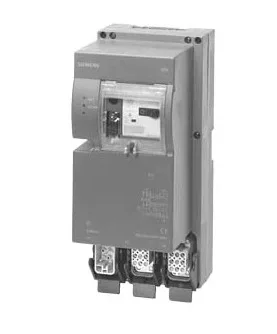
The Siemens 3RK1322-1KS02-0AA4 is an AS-interface compact starter — a self-contained direct-on-line (DOL) motor starter in an IP65 enclosure meant for mounting out on the machine frame, not back in the panel. It's a direct starter with electromechanical switching contacts and bimetal motor protection, rated for a setting range of 9…12 A. The IP65 rating means the whole unit — housing and connections — stands up to hose-down and dust ingress, so you can mount it on the machine frame in washdown areas or dusty environments without a separate cabinet. It communicates over AS-interface (AS-i), so it drops onto a two-wire bus for both power and data, cutting the point-to-point wiring back to the PLC. A built-in motor brake output (500 V DC / 1 A) handles the holding brake on vertical-axis motors or conveyors that need to lock on power loss.
The 5.5 kW rating at AC-3 (400 V) is the motor switching duty — that's the figure that governs whether this starter can handle your motor's starting and stopping under load. AC-3 covers starting and plugging/plugging-stop of squirrel-cage motors; if your motor nameplate says 5.5 kW or less at 400 V, this starter is sized for it. The setting range of 9…12 A on the bimetal overload matches the full-load current of a 5.5 kW motor at 400 V (roughly 11 A), so you dial the overload relay to the motor's FLA. The maximum short-circuit breaking capacity (Icu) at 400 V is 50,000 A — that's the fault current this unit can safely interrupt without blowing apart. That's a real number for selectivity studies. Ambient temperature range of -25…+55 °C during operation covers most industrial floors, but if you're mounting it near a hot motor or in a sun-baked enclosure, keep the upper end in mind — the bimetal trip curve shifts with ambient, so derate if you're running at the top of the range.
This compact starter is designed for machine-mounting, not DIN-rail inside a panel. The 9-pole motor outgoing feeder and 9-pole power connection handle the motor leads plus the AS-i bus and brake wiring — you're looking at a single cable entry for the motor, one for the bus, and the brake wires. Dimensions are 190 mm deep, 120 mm wide, 270 mm tall — about the size of a shoebox on its side — so plan the gland plate or bracket accordingly. It integrates into an AS-interface network directly — no PROFIBUS DP on this variant (says no). The two-wire AS-i bus carries both power and communication, so you run a single yellow cable from the AS-i power supply/gateway to the starter. The two integrated inputs let you connect limit switches or pushbuttons local to the motor without a separate I/O block.