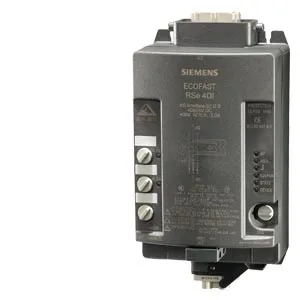
The Siemens 3RK1323-5BS44-3AA0 is a reversing starter — a compact motor control unit that combines a contactor pair with solid-state motor protection in one IP65 enclosure. It's built for reversing motor loads like conveyors, hoists, or gate drives where direction change is part of the cycle. Rated 3 A at AC-3 duty at 400 V, so it switches standard squirrel-cage induction motors up to that current — think 1.5 kW or so on a 400 V three-phase line. Operating voltage range is 400 to 500 V, supply voltage is 24 V DC nominal (20.4 to 28.8 V DC permissible, max 31.6 V). The 24 V DC control side is standard for industrial control panels — keeps the coil circuit isolated from the power side.
IP65 and field-mount design
This starter is meant for machine-mount or field-mount installation — not inside a cabinet. It's common on packaging lines, material handling equipment, or anywhere you'd rather put the motor control at the point of use than run long power cables back to a panel. Dimensions are 250 mm high, 130 mm wide, 91 mm deep. That's a compact footprint for a reversing starter with integrated protection. The enclosure has sockets for main energy infeed and load-side outgoing feeder per ISO 23570, plus M12 sockets for digital input signals. Supply voltage and communication transmission use AS-i shaped cables with cutting/clamping method — no separate wiring glands needed for those connections.
Motor protection and inputs
Motor protection is solid-state — no bimetallic overload relay to reset. It provides electronic overload protection with adjustable parameters via the digital inputs. There are 4 digital inputs total, 2 of them configurable for digital input signals via M12 sockets; 0 digital outputs on this variant. The digital inputs are parameterizable, so you can set the function (e.g., start/stop, reversing command, fault reset) through the AS-i network. Switching contact design is mechanical (the contactor pair), not solid-state. Minimum operating frequency is 1 cycle per hour — that's the rated mechanical endurance limit, not a thermal limit. For higher cycling rates, you'd need to check the application against the manufacturer's data.