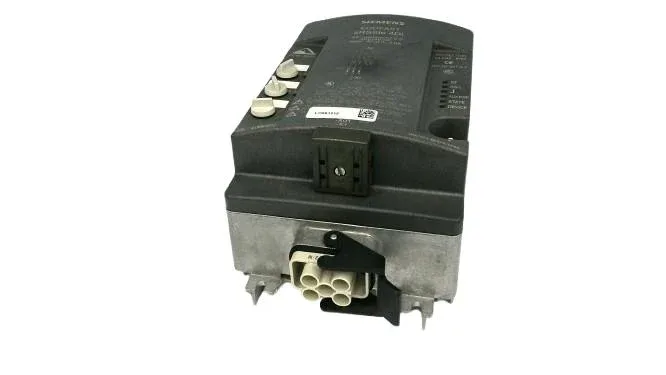
The Siemens 3RK1323-6BS74-3AA0 is a solid-state reversing starter designed for motor control in distributed automation architectures. The IP65 enclosure means the entire unit — electronics, I/O connections, and bus interface — is sealed against dust and low-pressure water jets. That makes it a straight drop into washdown zones, outdoor conveyor sections, or food-grade areas where a panel-mounted starter would need a separate enclosure. Communication rides on the AS-i bus, with PROFIBUS DP and PROFINET not supported on this variant. The supply voltage and communication both route through AS-i shaped cables using the cutting/clamping method.
For a 400 V three-phase motor, that covers small drives. Operating voltage spans 400 to 500 V. The control supply is 24 V DC nominal (20.4 to 28.8 V range, max 31.6 V). Four digital inputs are onboard, two via M12 sockets. That's enough for limit switches, E-stop feedback, or position sensors local to the starter.
The form factor is a reversing starter with dimensions of 130 mm wide, 250 mm high, and 107 mm deep. That's another SKU that won't share a bin with the 3RT contactor series — the 3RT1055-6LA06, 3RT1044-1FB46, and 3RT1054-1AB36 are electromechanical contactors, not solid-state reversing starters with integrated AS-i communication. If your panel was laid out for one of those, this unit won't drop in without rewiring the bus and control connections.
Integration notes
Mounting is via the IP65 enclosure — no DIN rail inside the housing. The unit connects to the AS-i network through the cutting/clamping method on shaped cable, so plan for that cable type in your BOM. The main energy infeed and load-side outgoing feeder both use sockets per ISO 23570, which is a standardized connector interface for distributed motor starters. Device addressing is done through a front addressing socket, not DIP switches under a cover. That's convenient if the starter is mounted in a tight spot — you can address it without pulling the unit off the machine frame. The motor protection is full motor protection, meaning it includes overload and short-circuit protection internally.