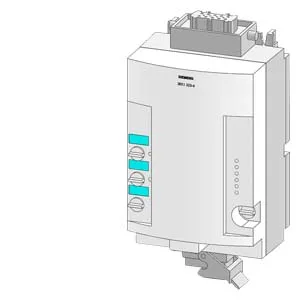
The Siemens 3RK1323-6DS74-3AA3 is a reversing starter with solid-state switching contacts, designed for motor control in distributed automation architectures. It is part of the AS-Interface (AS-i) product family, communicating and receiving power via the AS-i shaped cable — no separate control wiring for the coil circuit. The solid-state design means no mechanical contact wear during reversing operations, making it suitable for high-cycle applications where electromechanical contactors would require frequent replacement. Rated at 12 A at AC-3 duty class at 400 V, it handles reversing motor loads up to roughly 5.5 kW (typical 4-pole induction motor at 400 V).
The unit measures 250 mm high by 130 mm wide by 107 mm deep. The load-side outgoing feeder and main energy infeed use sockets according to ISO 23570, which means pre-terminated cables with the matching connector plug in without opening the housing. Supply voltage, communication, and digital input signals all connect via the AS-i shaped cable using cutting/clamping method, so the installer simply lays the cable into the slot and tightens — no stripping, no screw terminals. Four digital inputs are onboard, two of which terminate at M12 sockets for external sensors. The inputs are parameterizable, allowing the integrator to configure the input logic (PNP/NPN, debounce, etc.) through the AS-i master rather than hardware jumpers. There are no digital outputs on this variant, so any solenoid or indicator loads require an additional output module on the AS-i segment.
Motor protection and brake control
The unit provides full motor protection, meaning it includes integrated overload protection that tracks the motor's thermal state. This is not a simple bimetallic relay — it is electronic, using the solid-state switching to measure current and compute I²t heating. It also supports brake control with 400 V AC, so a mechanical brake on the motor shaft can be controlled directly from the starter without a separate brake rectifier or contactor. Operating frequency is rated at a minimum of 1 cycle per hour, which is a minimum switching frequency — not a maximum. This rating means the device is designed for applications where the motor reverses infrequently, such as conveyor diverter gates or valve actuators. For higher cycle rates (hundreds per hour), a different starter variant or a servo drive would be more appropriate.