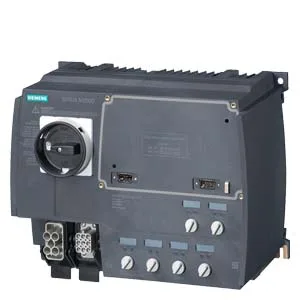
It integrates a contactor pair, overload relay, and control logic in one IP65 housing, so it handles forward/reverse control of a three-phase motor without external interlocking. The 24 VDC control supply (20.4–28.8 V range) powers the onboard electronics, including four digital inputs and two digital outputs, making it a drop-in node for a distributed control scheme.
Trip Class selectable between 5, 10, 15, and 20 — that sets the overload relay's thermal memory curve. For a motor with a short starting transient (e.g., a centrifugal pump), Class 10 is typical; for high-inertia loads like a conveyor, Class 20 gives the extra time to avoid nuisance tripping. The 400 V AC rated current of 2 A (0.75 kW) defines the maximum motor FLA this starter can switch in reversing duty. At 460/480 V the rating drops to 0.7 hp, and at 575/600 V to 1 hp — so the voltage derating is already baked into the spec lines. Mounting can be vertical, horizontal, or flat, with screw fixing. The recommended orientation is horizontal, which affects how the internal heat sink sheds the thermal load from the overload relay.
Integration notes
The housing measures 294 mm wide by 215 mm high by 148 mm deep — a substantial footprint for a reversing starter. The main circuit connection uses a HAN Q4/2 plug per ISO 23570, so the panel builder needs the mating connector and a gland plate that accommodates the 294 mm width. Four digital inputs and two digital outputs are available for local interlocks or status feedback; the supply is 24 VDC, and the control logic handles reverse starting directly (no external reversing contactor required).