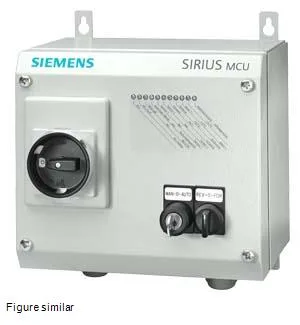
AS-Interface motor starter with integrated brake control
Its 0.63 A AC-3 rating at 400 V means it switches a motor load up to that current under the heaviest starting duty (inductive break), and the Trip Class 10 bimetal overload protects standard squirrel-cage motors during startup without nuisance tripping on normal acceleration. This is a current-production part — not a last-time-buy or obsolete line — so it remains a straightforward BOM line for new panel builds or AS-i drop replacements. The AS-Interface protocol support means it plugs directly into an AS-i network without a separate gateway module for the motor starter function, saving a slot in the cabinet.
The 0.63 A at AC-3 400 V is the motor-rated current — not the thermal or resistive rating. For a 400 V three-phase induction motor, this covers a roughly 0.25 kW load (about 0.33 hp). If your motor nameplate exceeds this, the starter will trip on overload or weld its contacts; this is the hard limit for the power circuit. The IP54 enclosure keeps dust and splash out, suitable for machine-mounted installation on a conveyor line or packaging cell, but not for washdown zones (that would need IP65 or higher). The control supply is 20.4 to 26.4 V DC, and the operating voltage for the main circuit spans 340 to 440 V AC at 50/60 Hz. The unit includes a motor brake output for 400 V AC brakes, so if your motor has an AC brake coil, this starter handles it without an external brake rectifier.
Its 245 mm width and 205 mm depth mean it occupies roughly the space of two standard contactors side by side; plan for that footprint in your panel layout. Two digital inputs are onboard, so you can wire local pushbuttons or a limit switch directly to the starter without a separate I/O block. The AS-Interface bus handles the communication — no PROFIBUS or PROFINET on this variant, so it stays in the AS-i domain only.