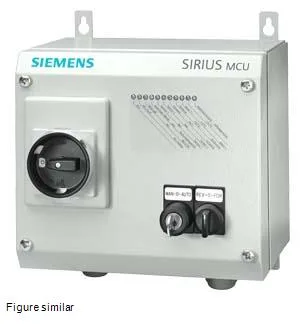
Active production — what it means for your BOM line
The 3RK4320-3DQ54-1BA3: No stock-holding claim — quoted per BOM.
What the 1.25 A AC-3 rating and CLASS 10 trip mean for motor starting
The same 1.25 A appears at 400 V for general AC use, so the motor full-load current must not exceed this figure. The bimetal design provides thermal memory: it tracks the motor's heating between starts. Operating frequency is rated 80 operations per hour — this sets the thermal cycling limit for the starter contacts and bimetal. Above 80 1/h, the internal temperature rise accumulates and may reduce contact life or cause premature overload trips.
Mounting, enclosure fit, and wiring constraints
The starter measures 205 mm deep, 245 mm wide, and 215 mm high. Plan for a 250 mm wide DIN-rail section inside the enclosure — the 245 mm width leaves 5 mm clearance on each side for rail-end anchors and wiring channels. This means you can orient the starter to fit tight enclosures or angled sub-panels, but the IP54 seal assumes the gasket is compressed evenly — avoid skewing the mounting screws. IP54 rating means dust-protected and splash-resistant — adequate for control cabinets in light industrial environments, but not for washdown zones. If the enclosure is in a wet area, the starter itself needs a sealed cabinet door.
AS-Interface bus integration and control supply
This motor starter communicates via AS-Interface protocol — no PROFIBUS DP or PROFINET support. The AS-i bus carries both the control signals and the 24 V DC supply; the control supply voltage range is 20.4…26.4 V DC, matching the standard AS-i power supply output. Two digital inputs are available on the starter for local sensors or pushbuttons — these are read over the AS-i bus. The reversing starter design means it has two contactors (forward/reverse) with mechanical interlock, wired internally. A motor brake output with 400 V AC control is integrated — this is for holding brakes on vertical-axis motors. The brake coil is switched directly from the starter; no external brake rectifier needed when the brake is rated 400 V AC.
Compliance and substance prohibitions
The substance prohibitance date is 05/01/2012 — this aligns with RoHS compliance milestones. The starter meets the substance restrictions in effect from that date; REACH and WEEE documentation should be available from Siemens on request.